

The angel of auschwitz, p.1
The Angel of Auschwitz, page 1
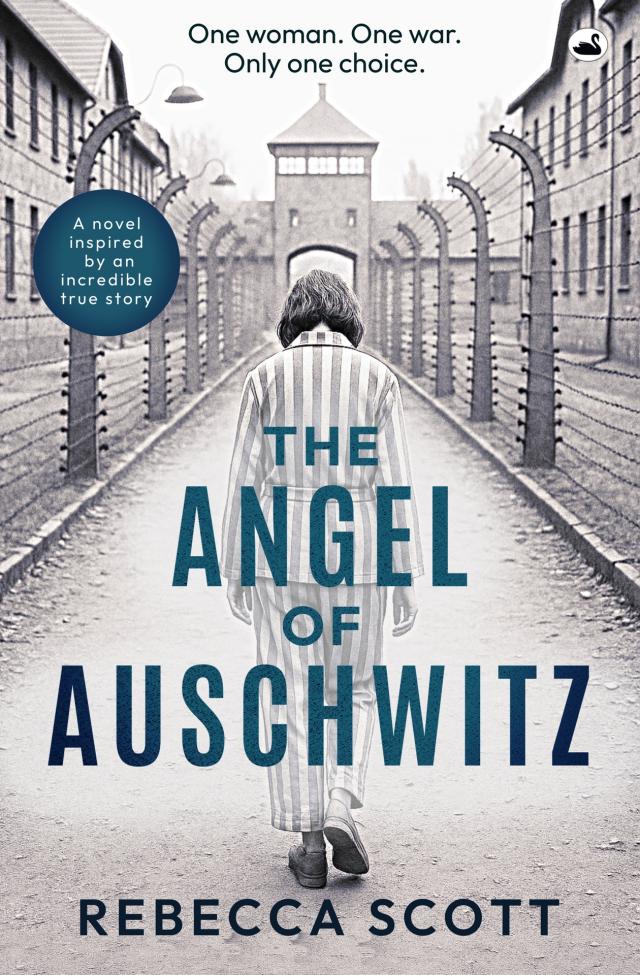


THE ANGEL OF AUSCHWITZ
REBECCA SCOTT
Copyright © 2025 Black Swan Digital
The right of Black Swan Digital to be identified as the Author of the Work has been asserted by her in accordance Copyright, Designs and Patents Act 1988.
First published in 2025
Concept created by Black Swan Digital. Developed by Abigail Ford.
Apart from any use permitted under UK copyright law, this publication may only be reproduced, stored, or transmitted, in any form, or by any means, with prior permission in writing of the author or, in the case of reprographic production, in accordance with the terms of licences issued by the Copyright Licensing Agency.
All characters in this publication are fictitious and any resemblance to real persons, living or dead, is purely coincidental.
CONTENTS
This story is inspired by true events.
Chapter 1
Chapter 2
Chapter 3
Chapter 4
Chapter 5
Chapter 6
Chapter 7
Chapter 8
Chapter 9
Chapter 10
Chapter 11
Chapter 12
Chapter 13
Chapter 14
Chapter 15
Chapter 16
Chapter 17
Chapter 18
Chapter 19
Chapter 20
Chapter 21
Chapter 22
Chapter 23
Chapter 24
Chapter 25
Chapter 26
Chapter 27
Chapter 28
Chapter 29
Chapter 30
Author’s Note
Have you read?
A Note From The Publisher
THIS STORY IS INSPIRED BY TRUE EVENTS.
1
JERUSALEM, 1978
Late-afternoon light drifted through the tall windows of the lecture hall, settling in narrow angled sheets across the rows of wooden desks. Dust hung in the air, stirred by the slow arrival of students taking their seats with the casual choreography of people who had no reason to imagine anything extraordinary would happen here today. Bags thudded softly onto floors. Pages rustled. Someone laughed, too loudly for the hour, and the sound echoed briefly before dissolving into the low, indistinct murmur rising from the tiered benches.
At the front of the room, an elderly woman stood beside the podium.
She had arrived early, when the hall was still empty, its silence a clean, unoccupied thing. Now she remained where she had been for some minutes, hands lightly touching the lectern as though confirming its solidity beneath her palms. Her posture was upright but not rigid, simply deliberate.
Gisella Perl looked small against the wide chalkboard that stretched behind her, her figure carved in light and shadow. A thin cardigan was draped over her shoulders. The neckline of her blouse held a faint shimmer of a chain beneath the fabric. Her silver hair was pulled back neatly, a few wisps softening the severe practicality of the style. She gazed out at the scattering of students with the quiet observation of someone who had learned, long ago, how to wait.
Most of them did not look at her twice. A few glanced, nodded politely, then resumed their conversations. One boy, pushing his glasses back up the bridge of his nose, held her gaze a fraction longer than the rest before lowering himself into a seat in the second row. Another girl wrapped her scarf tighter and whispered to her neighbour. They seemed very young to her – not merely in age, but in the way they moved, their shoulders unburdened, their faces unlined by knowledge they had not yet earned nor been forced to carry.
The room filled slowly. The hum of chatter thickened. The professor who had invited her stood at the side, checking his watch, but she did not look at him. She was listening to the students, their rhythms, their energy, feeling the pulse of a generation that had inherited stories like hers only in fragments. Some of them would have read her name on the lecture programme and not recognised it. Some would have come only because attendance was required. She felt no resentment in that. Everyone had their beginning somewhere.
A gust of cooler air swept in as the back door closed for the last time. The noise softened into expectant quiet. The professor stepped forward and cleared his throat.
“Students,” he said. “Today we are honoured to welcome a guest who—”
But he got no further. Gisella touched his sleeve lightly, enough to interrupt without seeming to do so. He hesitated, nodded, and stepped back. She moved to the podium with a steady breath, as though gathering herself into the present moment.
“Good afternoon,” she said.
The words were simple, her voice low but clear, carrying farther than one might expect from someone so slight. She waited until the faint rustle of shifting bodies died away. The students looked at her now, not all with interest, but with curiosity at least. She felt their attention settle, first out of courtesy, then out of something else: the awareness, perhaps, that the woman before them was not nervous. She was composed. And that composure was intriguing.
“My name is Dr Gisella Perl.”
A pause. Nothing dramatic. She simply let the name exist in the air, its weight and history unspoken. A few students sat up straighter, recognising it perhaps from something like a footnote, a documentary, a conversation overheard years earlier.
She continued, hands resting lightly on either side of the lectern.
“I was a doctor before the war. And I remained one after. In the years between,” her gaze moved across the room, neither lingering nor shying away, “there were circumstances I could not have imagined when I began my training.”
Silence settled deeply. Not fear, not pity but simply attention, drawn as if by gravity.
“I was asked,” she said, “to speak today not about the war itself, not yet, but about where I began. About who I was before history intervened.”
She looked down for a moment, as though arranging the past with care before lifting it into the light.
“It is a long lifetime ago,” she said softly. “But I remember.”
She drew a slow breath before continuing.
“I was born in Máramarossziget, in the north of Hungary. A town of narrow streets and steep roofs, where winters came early and stayed for a long time. I was the only daughter in a house full of boys. My father believed knowledge was a form of worship, so he allowed me to study alongside my brothers. He never called it unusual. He merely expected I would work hard.”
Something in her expression shifted almost imperceptibly. A softness around the eyes. A quiet warmth.
“I loved school. I loved books. I read anything I could get my hands on such as science, philosophy, anatomy, poetry. My teachers said I asked too many questions.” A faint, dry lift of her brow. “My father said that was the point.”
A few students smiled. She glanced at them with the smallest nod.
“When I was fourteen, I announced I would become a doctor. A Jewish girl making such a declaration in the 1920s was… unusual.” She let the word rest without bitterness. “My mother worried it would turn the world against me. My father said the world would adjust.”
Her voice remained steady, the rhythm unhurried. She told the story without embellishment, but her restraint gave the details a gravity more powerful than sentiment.
“I was accepted to the University of Budapest. The first day I walked through its gates, I carried two pencils, one notebook, and a courage I did not fully recognise as courage until much later.”
She looked briefly toward the window, where the light had begun to soften into gold.
“It was not easy. But it was possible. That was enough. At first, I studied medicine as one studies a language: mechanically, then clumsily, then with a kind of devotion. I found I had a particular interest in obstetrics and gynaecology. Women’s health was not yet considered a serious discipline then. Some of my professors told me I would find it limiting. I told them I preferred to work where the need was greatest.”
A few pages rustled as students shifted in their seats, leaning forward.
“After receiving my degree, I returned to my hometown to practise. Máramarossziget was small, but its people were vibrant. Jewish families, Christian families. We lived side by side. I treated anyone who came through my door. Women came with their daughters, their mothers, their sisters. They trusted me.”
Here, her voice softened almost imperceptibly.
“I delivered babies in kitchens, in bedrooms, in barns during winter storms. I attended to fevers, to injuries, to quiet confessions. I taught schoolgirls how to keep themselves healthy. Many of them had never been told such things. I remember their faces. Some were shy, some bold, some curious.”
The room felt still, as if even the dust in the air chose not to move.
“I married a surgeon, Dr Ephraim Krausz. He was kind, and brilliant in ways that complemented my own. We worked long hours, often crossing paths only briefly during the day. We had two children, a son and a daughter. Our home was always full of noise. We worked hard, but we were happy.”
There was no tremor in her voice when she spoke of them, no dramatic quiver. Only calm. The sort of calm that one builds carefully over years, like a protective wall around a wound.
“Life was ordinary,” she said. “And we believed it would continue. But the world was changing. Quietly at first, then less quietly.”
Her eyes moved across the hall again, settling br iefly on the boy in the second row.
“In the late 1930s, new laws were passed in Hungary. Restrictions on universities. Restrictions on professions. Restrictions on where Jews might work, or live, or be seen. Fresh notices appeared in windows like unwelcome guests. Some thought it would pass, that reason would return, that the old ways would reassert themselves.”
Her hands folded gently together on the podium.
“I thought so, too. I was wrong.”
The students remained silent. One girl’s pen hovered above her notebook, forgotten.
“The atmosphere in our town changed. People still greeted one another in the street, but the greetings grew shorter. Some friends stepped a little farther away. Some stopped writing. Some stopped looking us in the eye. Our children were old enough to notice. They asked questions I had no good answers for.”
For the first time, she paused long enough for the silence to thicken.
“I continued working. Babies continued to be born. Women continued to seek help. But the sense of safety, the sense that the world was fundamentally knowable, had begun to shift.”
Gisella exhaled slowly. It was neither a sigh nor a tremor, but something quieter, something like acknowledgement.
“History does not arrive all at once,” she said. “It approaches like fog, soft, then thicker, then impossible to ignore. One day you see the world clearly. The next, the path ahead is obscured.”
The students seemed to lean toward her in the stillness that followed. Even the professor at the side of the room, arms loosely folded, looked as if he were hearing some of this for the first time.
Gisella continued in a measured tone.
“By 1942, restrictions increased. Jewish physicians were dismissed from hospitals. Some were permitted to practise only on Jewish patients. Others were forbidden altogether. My husband and I continued our work quietly, unofficially, because the need was too great to do otherwise. But the pressure was mounting.”
Her hands rested again on the lectern. There was no tremor. Only the faintest tightening of her fingers.
“And then, in the spring of 1944, everything changed. Not suddenly… but definitively.”
She did not elaborate. She did not need to.
The air in the lecture hall felt heavier now, though no one moved.
“I will speak of that moment later,” she said. “Not today. Not in this first hour.”
Her gaze lifted again to the students, meeting them without flinching. The late-afternoon light brushed the side of her face, revealing the fine lines that decades had etched there, not frailty, but survival.
“I tell you this much because every story must begin before the darkest chapter. Before the rupture. Before the world divides into before and after.”
Her voice lowered slightly, not in weakness but in deliberation.
“In Máramarossziget, the last spring before the deportations was unusually warm. The trees bloomed early. Children played in the streets long after dusk. Mothers lingered on doorsteps, talking softly. There was a feeling, false as it turned out, that perhaps the worst had already come and gone. That normal life might stretch itself thinly over the fractures.”
She pressed a hand briefly to the lectern as if anchoring herself to the present.
“I remember one particular morning,” she said. “The windows were open. My daughter was plaiting her hair. My son was reading a book far too advanced for his age. My husband was preparing for surgery. I remember thinking absurdly, irresistibly, that the world could still be mended.”
She paused, the memory moving through her like a quiet current.
“But the air that morning felt different. Not in temperature. In… expectation. As if something had shifted just beyond our sight.”
A faint breeze stirred the curtains by the windows. The students were motionless, their notebooks open but untouched.
“That,” she said, “was the moment I first sensed what was coming. Not the details. Not the scale. Only the shadow. Long before anyone knocked on our door.”
Her eyes lowered to the wooden surface of the podium, its grain worn smooth by countless hands before hers.
“It is a strange thing,” she said quietly, “to recognise the beginning of an ending.”
The hall remained silent as she stepped back from the lectern, her hands lowering to her sides with composed finality, as though she were folding the memory closed for now.
Outside, the sun dipped lower, and the light across the desks thinned to gold.
“That morning,” she said, her voice barely above a whisper, “I understood that our lives were about to change, though I could not yet see how.”
And she left the sentence there unresolved, suspended gently in the space between remembrance and what waited beyond it, like the last breath before a door is opened.
2
1944
The light in the surgery held the gentleness of early spring. It entered through the square windows in muted gold, as soft as dust on a book spine, and settled over the shelves of glass jars and the neatly arranged instruments. The room smelled faintly of antiseptic and woodsmoke. A small iron stove stood in the corner, its heat fading but still present enough to warm the air.
Gisella stood beside the narrow bed where a young woman lay breathing in unsteady bursts. The sheets were rumpled beneath her and damp where her hands had clenched them. She was hardly more than twenty, with a heart-shaped face that had been lovely in calm moments but was now tight with pain.
“You’re doing well, Anna,” Gisella said quietly as she rinsed her hands in a basin of warm water. “Keep your breaths steady. Just like this.”
Anna’s eyes lifted toward her, wide and fearful. “It is too soon,” she whispered. “My husband is away. He doesn’t even know the birth has begun.”
“You will tell him soon,” Gisella replied while drying her hands. “Right now, the child needs you to stay present.” She spoke without haste. Fear made the body uncooperative and Gisella had learned that calm words helped more than comforting phrases. Anna took another breath and her shoulders shook.
Her mother stood at the foot of the bed, fingers twisting in the fabric of her apron. She looked at Gisella with a silent plea. Gisella gave her a small nod, enough to say that the situation was difficult but not hopeless.
Another contraction swept through the young woman. Anna bit her lip to hold back a cry. Her body arched and her fingers clawed at the sheet.
“Do not swallow the sound,” Gisella murmured. “Let your body work.”
She checked her with gentle hands, reading the progress with the surety of long practice. The baby was eager but not aligned perfectly. It would take time and care.
“Your breath is your ally,” Gisella said. “Stay with it. You will move through this.”
Anna nodded faintly. Her mother let out a breath of her own, relief and fear woven together.
Gisella crossed the room to prepare clean cloths. She placed them on a small tray and checked her instruments again out of habit. Order was not an affectation, it steadied her.
A gust of wind rattled the window. A few stray petals from a nearby tree drifted past the glass and fell into the street.
The next contraction arrived with force. Anna gasped and curled inward, her face flushed.
Gisella stepped closer and touched her shoulder. “Look at me,” she said softly.
The young woman lifted her eyes with an effort.
“You are not alone,” Gisella said. “Follow my count.”
Her voice was steady, and the rhythm of her breathing invited imitation. Anna’s breath matched it. Slow. Even. Controlled.
The contraction eased. The quiet afterward felt stretched.
Outside, a cart rattled over cobblestones. A dog barked far away. Otherwise, the town rested in its gentle spring afternoon.
“Bring the kettle to the stove,” Gisella told the older woman. “Half full. No need to hurry.”
Anna’s mother moved quickly, grateful for something useful to do.
Sunlight slipped across the floorboards. Shadows lengthened beneath the bed and under the small table where a jar of herbs waited for the evening.
The next contraction crested.






