

The elements of power, p.1
The Elements of Power, page 1


PENGUIN PRESS
An imprint of Penguin Random House LLC
1745 Broadway, New York, NY 10019
penguinrandomhouse.com
Copyright © 2026 by S. Nicolas Niarchos
Penguin Random House values and supports copyright. Copyright fuels creativity, encourages diverse voices, promotes free speech, and creates a vibrant culture. Thank you for buying an authorized edition of this book and for complying with copyright laws by not reproducing, scanning, or distributing any part of it in any form without permission. You are supporting writers and allowing Penguin Random House to continue to publish books for every reader. Please note that no part of this book may be used or reproduced in any manner for the purpose of training artificial intelligence technologies or systems.
PP colophon is a registered trademark of Penguin Random House LLC.
Brief portions of this work originally appeared, in different form, in articles published in The New Yorker from 2018 to 2025.
Image credits appear on this page.
Cover design: Elisha Zepeda
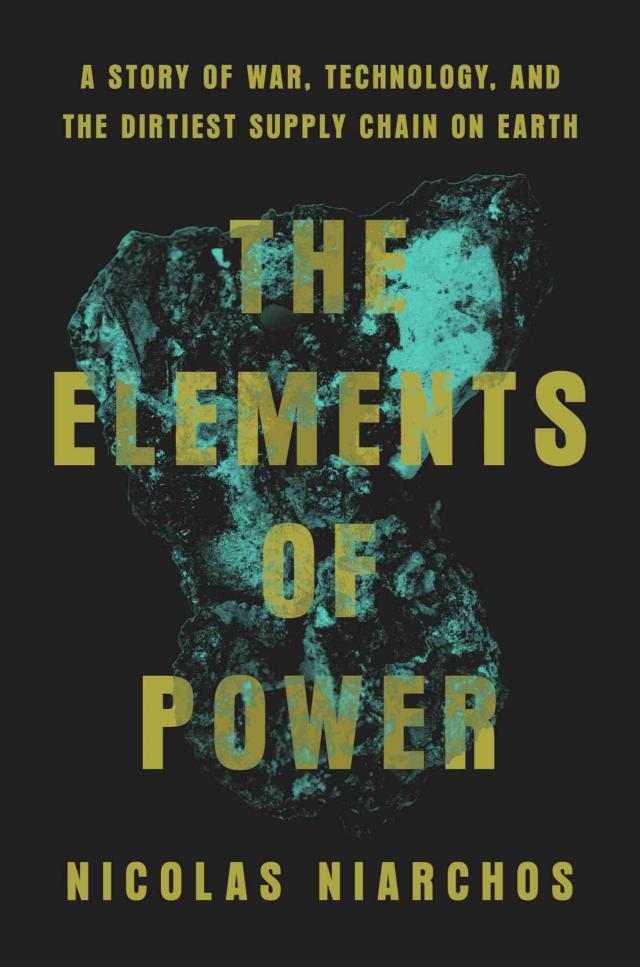
Cover image: (modified) Getty Images
Book design and map illustration by Daniel Lagin, adapted for ebook by Cora Wigen
Library of Congress Control Number: 2025009076
Hardcover ISBN 9780593492017
Ebook ISBN 9780593492024
International Edition ISBN 9798217061808
The authorized representative in the EU for product safety and compliance is Penguin Random House Ireland, Morrison Chambers, 32 Nassau Street, Dublin D02 YH68, Ireland, https://eu-contact.penguin.ie.
prhid_prh_7.4_154745601_c0_r0
Contents
Dedication
Epigraph
Cast of Principal Characters
Map of The Democratic Republic of the Congo and Locations Visited
Introduction: The New Power
Part 1: Fundaments
1. A Bend in the Lufilian Arc
2. The Great Rock That Spreads All Over the Lands
3. The Beginnings of a Battery
4. The Land of the Three Kings
5. The Prime Minister’s Tooth
6. A Patriot with a Cause
7. Liberty in a Wasteland
8. Intercalation Station
9. A Spy in Priest’s Clothing
Part 2: Trade and War
10. Putting Out Fires
11. A Cobalt Cathode and a Carbon Anode
12. The Milking Cow Falls Ill
13. A Battery and a Bubble
14. Getting Rich Is No Sin
15. Twilight of the Big Vegetables
16. Building Dreams
17. Fire Sale at the Karavia
18. Plans on the Back of a Comet
19. The Nightmare
Part 3: Battery Boom
20. Accelerating the Transition
21. Breaking the ICE
22. Le Petit
23. Into the Pits
24. Oozing Evil
25. A New Cathode
26. Nickel from the Forest
27. Crossing the River by Feeling for the Stones
28. China’s Answer to Dr. Zee
29. The Deal of the Century
Part 4: Consolidation
30. No Such Thing as Death
31. Kasulo
32. Bare Branches
33. Papa Solution
34. The Steve Jobs of Metals
35. Dirty Nickel
36. A Young Continent
37. Tokyo Drift
38. No Guts, No Glory
39. Tying Up the Supply
40. Green-Tinted Glasses
41. Seizing the Space
Part 5: Waking Up
42. God Is Smiling on Congo
43. The Spice of Life
44. Lithium Is Sexy
45. Next Energy
46. Red Seas
47. Buried Underground
48. Detained
49. An African Electric Car
50. Uncle Bunker
Afterword: Power Dreams
Acknowledgments
Note on Sources
Notes
Selected Bibliography
Image Credits
Index
About the Author
_154745601_
To the people of Congo, who deserve better
Within the techno-scientific set-up that seizes the world, there is no longer the sovereign good, nor even the happiness of humanity, its well-being and comfort. Humans have and will have to live and die without comprehending what is happening, why it is happening, how it is happening.
—Kostas Axelos, The Game of the World
Cast of Principal Characters
Robert R. Aronson: U.S. entrepreneur who pioneered electric vehicles in the 1960s–70s.
Clément Brasseur: Belgian lieutenant known as “Nkulukulu” for his brutal tactics.
Harry M. Caudill: U.S. Appalachian anti–strip mining activist.
Chen Xuehua: Founder of Zhejiang Huayou Cobalt.
Jules Cornet: Belgian geologist who in 1891 described Katanga as a “geological scandal” due to its mineral wealth.
George Forrest: Congolese businessman and miner.
Dan Gertler: Israeli mining entrepreneur.
John B. Goodenough: Nobel Prize–winning U.S. scientist, coinventor of the lithium-ion battery.
Aminatou Haidar: Sahrawi human rights advocate.
Alex Hayssam Hamze: Congolese mining entrepreneur.
Hassan II: King of Morocco, 1961–99.
Kalala Ilunga: King of the Baluba, circa sixteenth century.
Joseph Kabila Kabange: President of the Democratic Republic of the Congo, 2001–19.
Laurent-Désiré Kabila: Leader of the AFDL rebels. President of the Democratic Republic of the Congo, 1997–2001.
Odilon Kajumba Kilanga: Artisanal miner from Lubumbashi.
Joseph Kufi Kilanga: Government official under Mobutu’s regime.
King Leopold II: King of Belgium, 1865–1909; established the Congo Free State in 1885.
Patrice Lumumba: Congo’s first prime minister after independence in 1960.
Fifi Masuka Saini: Governor of Lualaba Province after 2023.
Mobutu Sese Seko: President of Congo / Zaire, 1965–97.
Mohammed VI: King of Morocco, 1999–present.
Msiri: King of the BaYeke who built an empire in Katanga in the mid-1800s.
Elon Musk: CEO of Tesla.
Richard Muyej Mangez Mans: Governor of Lualaba Province, 2016–23.
Jason Sendwe: Leader of the Balubakat during Congo’s postindependence conflicts.
Suharto: President of Indonesia, 1967–98.
Félix Antoine Tshisekedi Tshilombo: President of the Democratic Republic of the Congo, 2019–present.
Moïse Tshombe: Katangese politician who led the mineral-rich province’s secession from Congo from 1960 to 1963.
Wang Chuanfu: Founder and CEO of BYD Company.
M. Stanley Whittingham: Nobel Prize–winning British chemist who developed the first lithium-ion battery while working at Exxon in the 1970s.
Xiang Guangda: Chairman of Tshingshan Holding Group.
Akira Yoshino: Nobel Prize–winning Japanese chemist. Coinventor of the lithium-ion battery.
Robin Zeng Yuqun: Founder and chairman of CATL.
Introduction
The New Power
Lithium-ion batteries make the modern world possible. First commercialized in 1991, they put powerful tech at our fingertips, tools to get around, ways to be more and more connected.
Take the iPhone 16. The top model, Apple said, can run for thirty-three hours while playing video. It has a forty-eight-megapixel camera and a built-in AI system to scan objects. You can use the phone to call your mother, to trade in decentralized cryptocurrency, and, if you had lost something under your bed, you could use it as a flashlight. None of this would be possible without a substantial source of charge from a lithium-ion battery.
Electric vehicles like Teslas and BYDs use similar batteries, just on a larger scale, to hum soundlessly and smokelessly around our streets. And as technology develops and has to meet new standards, it will need better batteries to keep its tech humming: For the iPhone 17 Air, for example, engineers worked on developing a “high density” battery to reduce its size without compromising on power.
But humanity has also made a Mephistophelian bargain with batteries. The raw materials used to build them come from every corner of the globe: metals like lithium, cobalt, and nickel, as well as materials like graphite, silicon, and phosphate. To access them, tech profiteers, politicians, and battery makers have made a trade-off: cleaner power at home for pollution and suffering elsewhere. We have, explicitly or implicitly, accepted some of the pernicious consequences of the power revolution as inevitable, including the risk of human-rights abuses and labor exploitation, without much thought about how to mitigate these externalities.
The metals and materials that have gone into these batteries are often rare. They come from complicated parts of the world. It was not for nothing that people who knew metals would say, in the first decades of the twenty-first century, that batteries and green energy had created the greatest dislocation of demand and supply in their lifetimes.
The twentieth century was powered by oil, but by the second decade of the twenty-first century, we have developed myriad ways to store power without using fossil fuels. Among these methods, lithium-ion batteries have come to dominate. Batteries are globalized products—they are built from materials mined in one place, refined in another, assembled somewhere else, and eventually sold in yet another, crisscrossing a multitude of borders in the process—and without globalization, it would be impossible to build them or the computers, telephones, and cars they power. Politicians may claim otherwise, but global trade and supply chains are the only way that such products, especially at the scale modern society demands, can exist. Understanding these batteries and how they are made is key to understanding how a new form of power is being created, one that is measurable in dollars, strategic influence, and volts.
Lithium-ion batteries are produced using supply chains that are vulnerable to geopolitical rivalries, most notably the rivalry between China and the United States and Europe. Through strategic investment, Beijing has taken control of large parts of the extraction and refining of battery metals, and by 2024 one report estimated that 70 to 90 percent of lithium-ion batteries were being made in China. Critical metals have been as valuable in times of war as in times of peace. History is rife with examples of nations that failed to secure access to raw materials and suffered defeat in conflict or serious disadvantages in peacetime.
Like all revolutions, the battery revolution has had its winners and its losers. Lithium-ion batteries have helped create great fortunes. Elon Musk’s share of the electric car company Tesla was the single greatest contributor to him becoming, in 2021, the world’s wealthiest man, and Apple and Microsoft, two companies whose portable devices rely on the batteries, vie for the title of the world’s richest. Meanwhile, at the other end of the spectrum, people have toiled in squalid conditions, in poverty and human bondage, to extract the minerals needed to make these batteries.
And, as with oil, battery power has increasingly become political power. Musk arguably became one of the most influential people in U.S. politics after putting an outrageous $288 million behind Trump’s 2024 presidential bid and buying himself a seat at the table of governance, only to flame out, mid-2025, partly over disagreements over electric vehicle policy. But even his grasp of the complex issues behind where these batteries come from does not seem solid: In a 2023 shareholder meeting, Musk answered a question about child labor by saying he would put webcams in cobalt mines to check whether underage miners were descending into unsafe pits. His answer belied ignorance of how and where this mining actually happened.
In the end, Tesla provided only a monthly satellite image of its main cobalt source, the Kamoto Copper Company mine in the Democratic Republic of the Congo.
* * *
The critical metals conundrum has begun to register in the halls of power. The rush for critical minerals is fueling geostrategic shifts and shaping conflicts around the world. Soon after his inauguration in January 2025, President Donald J. Trump’s team began scouring the globe for minerals, from Greenland to Ukraine, even if the people who lived over them were less than willing to countenance signing them over to the U.S.
Then, on a Wednesday in mid-March 2025, Bret Baier, the host of Fox’s prime-time Special Report, turned his attention to another mineral-rich nation, the Democratic Republic of the Congo. Many of the minerals used in lithium-ion batteries exist in gigantic quantities in Congo,[*] but they are hard to access, partly because the country has been racked by near-continuous conflict since 1997 and suffers from deep-seated corruption. Special Report was one of the most popular cable news shows on television, and Trump was known to be a regular viewer. That Wednesday, a special guest appeared on videolink: the president of Congo, Félix Antoine Tshisekedi Tshilombo.
Dressed in a midnight-blue tunic, Tshisekedi at first looked a little uncomfortable. It was his first time on Fox. But the president soon found his flow as he began to talk about the subterranean wealth of his country and a potential deal with the new U.S. presidential administration. “We have established partnerships with many other countries, and we think the United States of America, given its role and influence around the world, is an important partner to have,” Tshisekedi told Baier. He was offering Congo’s ores for metals like lithium and cobalt, as well as for tantalum and copper, which are key to other parts of electric devices. China had long controlled his country’s natural resource trade, he said, and the U.S. was “waning” in Africa.
Tshisekedi had a problem: A rebel group, supported by Congo’s pugnacious neighbor, Rwanda, had seized large areas of his country’s East, and his corrupt army and government were ineffective at defending his people. While the sources of the conflict were many, it was partly fueled by a competition for valuable resources. He was turning to Trump to fund his fight using revenues from mining. If the president helped him, Tshisekedi implied, the U.S. would be allowed privileged access to battery minerals. “Whatever deal is made, Tshisekedi wants to make sure that it benefits the DRC,” Karl Von Batten, the chairman of the Development Committee of the District of Columbia’s Republican Party and one of Tshisekedi’s lobbyists in Washington, told me. Tshisekedi wanted, as Von Batten put it, a deal that benefited his population, people who would “not just extract like the Chinese,” but mostly he wanted money, weapons, and military might to help fight the invaders. In response, he was promising access to the rudiments of power, and a chance to beat China at its own game.
Trump was looking at foreign policy in transactional terms, a senior Republican official involved in shaping Africa policy told me on a visit to Washington that spring. The official was cautiously optimistic about a deal, but worried that the Congolese, who had a history of backsliding, might be preparing to stab them in the back. The prize was worth investigating, but he was worried that the U.S.’s prime foreign policy adversary, China, was also maneuvering to remain in control of vast swaths of the world’s critical minerals. “Let’s recognize that Tshisekedi could be just using this to get leverage in another deal with the Chinese,” he said.
Trump’s administration would end up penning a deal that would increase U.S. investment into Congo. Firms like KoBold, a mining firm backed by the likes of Jeff Bezos and Bill Gates—men whose fortunes had been made in tech and were almost as large as Musk’s—began eyeing potential deals in Congo for critical metals like lithium. “Under Tshisekedi, Chinese interests have continued to expand in Congo,” the official told me. “As much as he purports to be Western-orientated, a question mark remains. It’s always in the back of my mind: Are we being played?”
* * *
Battery wars had already caused upheaval around the world, but people who use lithium-ion gizmos have also begun to focus on the detrimental effects at the bottom of the supply chain. When the iPhone 16 was released on September 20, 2024, for example, demonstrators gathered outside Apple Stores in over a dozen cities. Many of them waved Congo’s colors—the vivid blue, red, and yellow of the country’s flag—in the early-autumn air. They were there to decry what they called a “silent genocide” in Congo, and they accused Apple, a company worth some $2.6 trillion at the time, of profiting off the Congolese, some of the poorest people in the world. Apple was fueling a series of conflicts and condoning child labor, they said. The protesters exhorted would-be Apple buyers: “Don’t scroll with bloody hands.”
Lawyers for the government of Congo had filed suit against Apple earlier that year in France and Belgium. (The French case was later dismissed.) “Apple has sold technology,” they wrote, “made with minerals sourced from a region whose population is being devastated by grave violations of human rights.”
It was not just left-wing activists who were critical. The company had based its supply chain in China, which enraged human rights advocates and hawks alike. The former argued that pollution and abusive labor standards were tolerated by Chinese companies; the latter said that Apple was farming out its supply chain to the U.S.’s chief adversary.
Apple’s representatives had long insisted that its batteries were produced virtuously. The company, after all, audited its supply chain to make sure that minerals connected to human-rights abuses did not wind up in its devices. It was true, moreover, that there were many different kinds of lithium-ion batteries, some with more negative externalities than others. And Apple insisted that its cobalt—a metal whose supply chain was one of the dirtiest among all those that went into making the phone—was recycled. A press release touted how much was reused: 100 percent of the cobalt in the iPhone 16 battery and 95 percent of the lithium.






