

Phoenix extravagant, p.1
Phoenix Extravagant, page 1


PRAISE FOR YOON HA LEE
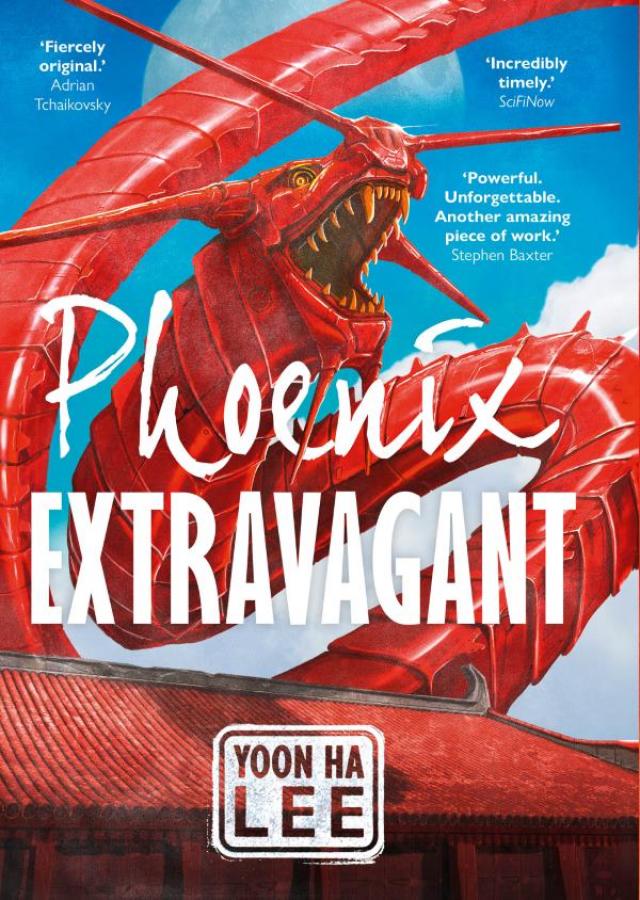
‘Powerful. Unforgettable. This is another amazing piece of work, and I have the feeling I need to read it again to get it fully!’
Stephen Baxter
“A fiercely original and enchanting new fantasy.”
Adrian Tchaikovsky
"A story of art, love, human connection, the power of creation, colonialism, and the roles we all have to play in fighting oppression."
Paul Weimer
“A smart, thought-provoking book, and one which feels incredibly timely.”
ScFiNow
‘Yoon Ha Lee has arrived in spectacular fashion.’
Alastair Reynolds
‘The story is dense, the pace intense, and the East Asian setting might make it seem utterly alien to many readers—yet metaphors for our own world abound. Readers willing to invest in a steep learning curve will be rewarded with a tight-woven, complicated but not convoluted, breathtakingly original story.’
N. K. Jemisin, The New York Times
‘I love Yoon’s work! Solidly and satisfyingly full of battles and political intrigue, in a beautifully built setting that manages to be human and alien at the same time.’
Ann Leckie
‘A density of ideas and strangeness that recalls the works of Hannu Rajaniemi, even Cordwainer Smith. An unmissable debut.’
Stephen Baxter
‘Sheer poetry. Every word, name and concept in Lee’s unique world is imbued with a sense of wonder.’
Hannu Rajaniemi
‘Pushes the frontier of science fiction. A must-read.’
Kirkus Reviews
‘Thoughtful, intricate, and completely human.’
Tor.com
‘Readers who don’t mind being dropped in the deep end will savor this brilliantly imagined tale.’
Publishers Weekly Starred Review
‘Lee’s prose is clever and opulently detailed; the worldbuilding is jaw-droppingly good.’
Ars Technica
‘Rather than aping the generic clipped-and-grim style so often employed by other, less talented writers, Lee leans in the other direction, finding a sumptuous beauty in physical moments and complexity in thought and motivation.’
NPR
‘Daring, original and compulsive. As if Cordwainer Smith had written a Warhammer novel.’
Gareth L. Powell
‘For those itching for dense worldbuilding, a riproaring plot, complex relationships, and a deep imagination, it’ll do just the trick.’
Tor.com
‘Lee’s ability to balance high concept with a deep examination of character is nigh unprecedented.’
B&N Sci-Fi & Fantasy Blog
“Phoenix Extravagant marks a different way of looking at Empire and power and living within, under, and against that than Lee’s first novels, but no less a powerful one. A fantastic, brilliant undertaking.”
Waterstones Bookseller’s Review
‘Ambitious. Confusing. Enthralling. Brilliant. These are the words I will use to describe Yoon Ha Lee’s utterly immersive, utterly memorable novel. I haven’t felt this blown away by a novel’s originality since Ancillary Justice. And, since I’m being completely honest, Ninefox Gambit is actually more inventive, boundary-breaking, and ambitious than that.’
The Book Smugglers
‘For sixteen years Yoon Ha Lee has been the shadow general of science fiction, the calculating tactician behind victory after victory. Now he launches his great manoeuvre. Origami elegant, fox-sly, defiantly and ferociously new, this book will burn your brain. Axiomatically brilliant. Heretically good.’
Seth Dickinson
‘A high-octane ride through an endlessly inventive world. Bold, fearlessly innovative and just a bit brutal, Lee deserves to be on every awards list.’
Aliette de Bodard
‘That was a great read; very intriguing world building in particular.’
Tobias Buckell
‘A striking space opera by a bright new talent.’
Elizabeth Bear
‘“You know what’s going on, right?” Lee asks. Often, you have to say, “Uh, yeah, of course,” when the real answer is “I have no idea, but I really, really care.” And then you keep reading.’
Strange Horizons
‘I expected intrigue and entertainment; I wasn’t prepared for all the feelings.’
The Speculative Herald
‘Readers may note echoes of or similarities to Iain M. Banks, Hannu Rajaniemi, C. J. Cherryh, Ann Leckie and Cordwainer Smith.’
Worlds Without End
‘Lee is ruthlessly clear-eyed about the costs and concerns of war and gives us an instantly ingratiating heroine who spends most of the book doing her best to outmaneuver the forces that have set her up to fail.’
RT Book Reviews
First published 2020 by Solaris
an imprint of Rebellion Publishing Ltd,
Riverside House, Osney Mead,
Oxford, OX2 0ES, UK
www.solarisbooks.com
ISBN: 978-1-78618-317-0
Copyright © 2020 Yoon Ha Lee
Cover art by DoFresh. Cover design by Dominic Forbes.
The right of the author to be identified as the author of this work has been asserted in accordance with the Copyright, Designs and Patents Act 1988.
All rights reserved. No part of this publication may be reproduced, stored in a retrieval system, or transmitted, in any form or by any means, electronic, mechanical, photocopying, recording or otherwise, without the prior permission of the copyright owners.
ONE
GYEN JEBI STROVE to keep their hand from shaking as they dipped their brush into the paint they’d mixed from pigments, a part of every artist’s training. Remember, they reminded themself, you’re good at art. There’s no reason to be nervous.
That didn’t do anything to soothe their nerves. They sat in a large room along with eleven other painters taking the Ministry of Art’s examination, light filtering in through paper-covered windows, which gave everything a dreamlike aspect. The other painters varied in age, but most of them looked like they were in their twenties. Jebi themself would turn twenty-six on the New Year, when everyone grew a year older.
They’d already completed the first three parts of the examination, which tested the artist’s ability to paint the most important subjects: first bamboo (easy), then landscape (mostly easy, unless you were ambitious and tried to outshine that famous painting of the Diamond Mountains), figure painting (a girl greeting a bird, in case the examiners were feeling sentimental). The last, hardest part of the exam was flower painting.
Jebi had mixed feelings about flowers. Even in past eras, choosing the wrong flower could indicate political opinions or innuendo; such games were even more dangerous now. The land of Hwaguk had been conquered and renamed Administrative Territory Fourteen by the Empire of Razan six years ago, although the Razanei presence went back years before that. And every flower had a meaning, and Razanei and Hwagugin associations were sometimes, but not always, the same.
I will be conventional, Jebi decided. Cowardly, but they needed this job. They were tired of eking out an existence painting crude tigers and frogs for collectors of folk art, even if it weren’t for the trifling matter of that debt. Jebi yearned for a chance to paint real art, to spend time with a community of like-minded artists—even if that meant working for the Razanei government.
Their sister Bongsunga wouldn’t understand, never had. Bongsunga had said that Jebi was welcome to stay with her as long as necessary. But Jebi knew what they made selling folk art, they knew what they owed the moneylender, and they knew what the Ministry of Art paid its staff artists. They didn’t understand why the Razanei were so eager to recruit Hwagugin artists, but they didn’t care. With any luck, they’d secure a comfortable position painting portraits of scowling officials, making them less scowly in the process. They could soothe their aching conscience by painting the moonscapes and native birds that called to them in their off hours.
If they dithered any longer, the paint would dry on the brush, and then where would they be? Jebi bit their lip, then settled on a peony, inoffensive in both Razanei and Hwagugin symbolism. Either way it represented romance and prosperity.
With deft strokes, Jebi finished the painting, depicting the peony with a single petal curled as though about to fly away. It was in the looser, impressionistic style that the Westerners had made popular among the Razanei. Jebi had mixed feelings about foreigners adulterating a tradition of art going back centuries, but even they had to concede that fashions changed, whether or not foreigners were involved.
Like everyone in the examination room, Jebi had come dressed in the modern clothes that the Razanei had introduced. For all her complaints, Bongsunga owned similar outfits. In parts of the former capital—now styled Administrative City Fourteen; at least the Razanei made things easy to remember—wearing native clothes wasn’t safe. Easier to put on shirts and slacks, also styles imported from the West, and fit in.
Jebi’s only concessions to Hwagugin tradition were two knotted mae-deup charms under their shirt, one bought from a charm-seller just yesterday. People had divided opinions on whether luck was like wine or flowers: that is, whether magic charms grew in power over time, or withered and had to be replaced. Jebi had split the difference by borrowing one from their sister and picking up a new one in the same style. One in red cord, one in blue, together suggesting the flow of yang and yin.
They didn’t wear the charms openly. Mos t Razanei scoffed at Hwagugin superstition, although charms were usually reliable as far as magic went. But the red and blue specifically evoked the yin-yang taegeuk symbol of old Hwaguk.
Besides waiting for the paint to dry—something it did rapidly on the absorbent hanji paper—they had to do one final thing before they could consider themself done with the exam. They’d done it three times before; they could do it once more, even if guilt pricked at their heart.
Jebi bit their lip, then dashed out a signature in Razanei script, making sure it was legible: Tesserao Tsennan.
It was a Razanei name, not a Hwagugin one. Tsennan meant bud, which appealed to Jebi’s sense of irony. Hwaguk meant flower land, which either referred to the spectacular springtime displays of azaleas and forsythias and plum blossoms or to the beauty (or seductiveness) of its people, depending on how bawdy you liked your poetry.
Like a growing proportion of Hwagugin, Jebi was fluent in Razanei. And like a small but significant number of their people, they sometimes found it convenient to go by a Razanei name. The two peoples resembled each other to a strong degree, after all: both black-haired and brown-eyed, with tawny skin, not too tall and slight of build. The Razanei administration encouraged the name changes and had set up a Registry of Names for Fourteeners, as they referred to their subjects. Jebi had lost no time in signing up, although they’d waited until their sister was at the market to get this done because they hadn’t fancied a quarrel, especially over the registration fee.
Tesserao Tsennan.
As the paint dried, Jebi thought wistfully that they wouldn’t mind signing their own name to their paintings. But if wishes were wings, all the world would fly. In the meantime, they needed the job.
They washed the brush out in the provided ceramic container, quotidian stoneware rather than the nicer white porcelain cup they used at home. The examiners did permit people to bring their own brushes. Privately, Jebi thought this was likelier to be a cost-cutting measure on the government’s part than a concession to artistic quirks.
The examiner at the head of the room sat with an open book, gazing imperturbably at all the examinees. Jebi stared frankly at him, wondering why he had brought the book if he wasn’t going to read it. Since nobody was allowed to leave early, Jebi entertained themself by imagining how they would draw a caricature of the man. Definitely exaggerate that unseemly beak of a nose, plus the gray hairs sprouting out of his ears. Maybe compare him to a tiger, cliché as it was? A balding white tiger, with a ferocious but comical roar.
With a start, Jebi realized that the man was staring back at them, with ill-concealed hostility. Hastily, Jebi jerked their gaze away and looked down at their four paintings, neatly arrayed on the table before them. Surreptitiously, they checked out the competition, cataloging faults, from sloppy brushstrokes to wobbly composition. Their confidence grew; their paintings were clearly among the best.
By the time the gong rang from outside, signaling an end to the examination, Jebi’s head was throbbing. They had eaten only a light breakfast of rice porridge with a few shreds of chicken in the morning. They couldn’t wait to get some food into themself.
“Please leave your paintings in place and exit the room single-file,” the examiner said in a gravelly voice. “The results of the exam will be posted on the Ministry of Art bulletin board in three days.”
Jebi gathered up their coat in anticipation of the cold outside. It was early enough in the winter that they had worn a lighter coat. The heavier one had a prominent ink stain that Jebi and their sister hadn’t been able to remove despite hours of scrubbing.
Jebi was the second-last to leave the room, following the other hopefuls through the hallway and out of the building. From the outside, it looked like any other ministry building, with its peaked roof and roof-tiles sporting stylized plum blossoms. But the old signs in Hwamal, the language Jebi had grown up speaking, had been replaced by new ones in Razanei script.
It doesn’t matter, Jebi thought. The Ministry of Art was still the Ministry of Art, no matter what language it was labeled with.
One of the other examinees fell in step with Jebi as they headed east toward a street with food carts. She was a drab young woman, her earlobes elongated by long earrings that jingled distractingly. Jebi wondered for a moment if they’d paint her ears faithfully, or exercise some aesthetic judgment and paint them without the stretching.
“How many of us do you think they’ll accept this round?” the woman asked breathlessly. She couldn’t have been older than sixteen or seventeen years, fresh-faced, her plump cheeks already reddening in the chill air.
Jebi fought down an irrational surge of jealousy. “I’m sure the Ministry has plenty of positions,” they said with false cheer. Did the Ministry even accept youths? “If you’ll excuse me, I need to get something to eat.”
The woman’s face fell, and Jebi lengthened their stride, leaving her behind in the afternoon crowd of people with government business, couriers, and, most unnerving of all, automata.
Jebi’s heartbeat sped up when they spotted the automata. From a distance they resembled ordinary people. They even wore clothes and smart black boots like ordinary people, to the extent that their blue uniforms were ‘ordinary,’ down to the golden Sun in Glory badges upon their chests and the vicious curved swords any Hwagugin would have been arrested for carrying. But the masks—their wooden masks showed blank visages with cut-outs for eyes, no nostrils, no mouths, only peculiar painted motifs.
Intellectually, Jebi knew that the automata would not harm them. Jebi hadn’t done anything. Unlike human police—whether Hwagugin collaborators or Razanei occupiers—the automata were impartial. They didn’t pick on drunks out of spite, or demand bribes, or beat up people who looked at them crosswise. But neither did they understand mercy, and they didn’t talk.
A patrol of automata and their human interpreter, who could be identified by her necklace and bracelets of wooden beads, marched past as Jebi got in line in front of a food cart selling fried pancakes stuffed with jujubes, nuts, and melted brown sugar. Jebi did not have as much of a sweet tooth as their sister, and they should save money until they knew they had passed the Ministry of Art examination—the Razanei had a positive obsession with paying on time—but they were so hungry. Their stomach growled as they inhaled the rich smells of the frying pancakes.
It’ll be all right, Jebi thought as they counted out the money for two pancakes. They had spent all their life practicing painting, even before the Razanei invaded; had scrimped for lessons from the best teachers they could find. Bongsunga hadn’t understood, exactly, but she had made her own sacrifices to help Jebi in their pursuit of art. And Jebi had seen the others’ paintings. There was no way they had failed the exam.
The pancake-seller made an especial production of Jebi’s pancakes, flipping the dough ostentatiously and juggling their circular spatula. Jebi smiled back, although they didn’t intend anything more than a harmless friendliness. Behind them, two people were talking about the latest Razanei troop movements as they continued to harry the rebels. The Army had recently secured an ancient Hwagugin observatory; Jebi was only middling educated in the ways of astrology, but their sister had a passion for it. They doubted the Razanei cared about stars and celestial cycles. It was probably about securing the high ground, one of the few military principles Jebi had any familiarity with.






