An ordinary youth, p.1
An Ordinary Youth, page 1


WALTER KEMPOWSKI (1929–2007) was born in Hamburg. During World War II, he was made to serve in a penalty unit of the Hitler Youth due to his association with the rebellious Swingjugend movement of jazz lovers, and he did not finish high school. After the war he settled in West Germany. On a 1948 visit to Rostock, his hometown, in East Germany, Walter, his brother, and their mother were arrested for espionage; a Soviet military tribunal sentenced him to twenty-five years in prison, of which he served eight at the notorious “Yellow Misery” prison in Bautzen. In 1957 he graduated high school. His first success as an author was the autobiographical novel An Ordinary Youth (1971), part of his acclaimed German Chronicle series of novels. In the 1980s he began work on an immense project, Echo Soundings, gathering firsthand accounts, diaries, letters, and memoirs of World War II, which he collated and curated into ten volumes published over twenty years, and which is considered a modern classic.
MICHAEL LIPKIN is a translator and scholar of German literature. His writing has appeared in The New Left Review, The Times Literary Supplement, The Nation, and The Paris Review, among others. He is currently a visiting professor of German studies at Hamilton College in Clinton, New York.
OTHER BOOKS BY WALTER KEMPOWSKI
PUBLISHED BY NEW YORK REVIEW BOOKS
All for Nothing
Translated by Anthea Bell
Introduction by Jenny Erpenbeck
Marrow and Bone
Translated by Charlotte Collins
AN ORDINARY YOUTH
WALTER KEMPOWSKI
Translated from the German by
MICHAEL LIPKIN
NEW YORK REVIEW BOOKS
New York
THIS IS A NEW YORK REVIEW BOOK
PUBLISHED BY THE NEW YORK REVIEW OF BOOKS
207 East 32nd Street, New York, NY 10016
www.nyrb.com
Copyright © 1978 by Albrecht Knaus Verlag, a division of Penguin Random House Verlagsgruppe GmbH, Munich, Germany
Translation copyright © 2023 by Michael Lipkin
Translator’s note copyright © 2023 by Michael Lipkin
All rights reserved.
Original German edition first published in 1971 as Tadellöser & Wolff. First published as a New York Review Books Classic in 2023.
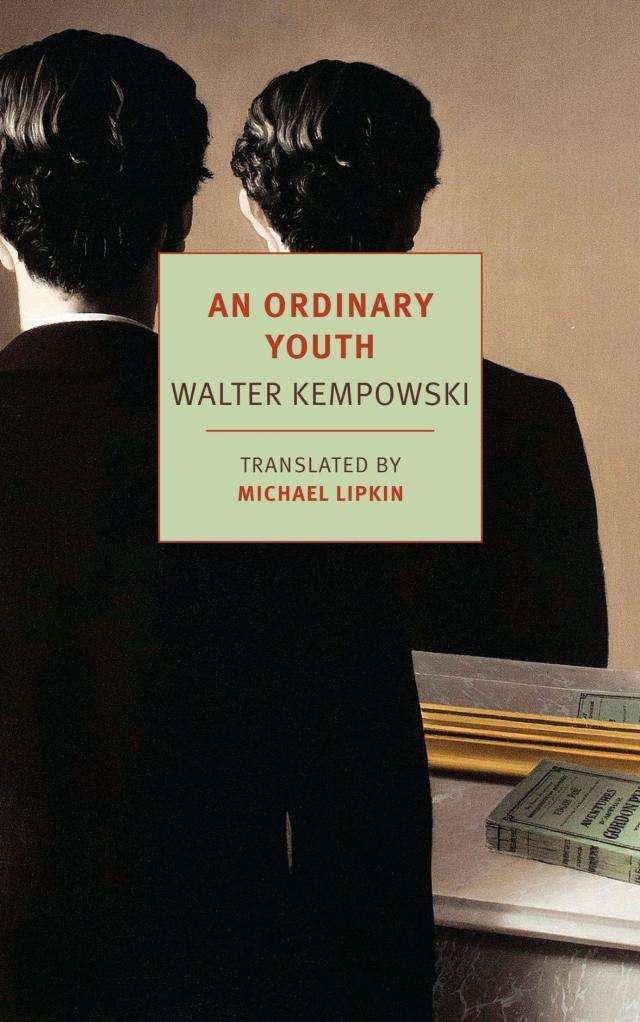
Cover image: René Magritte, Not to Be Reproduced, 1937; © 2023 C.
Herscovici / Artists Rights Society (ARS), New York; photograph: © Fine Art
Images / Bridgeman Images
Cover design: Katy Homans
The translation of this work was supported by a grant from the Goethe-Institut.
Library of Congress Cataloging-in-Publication Data
Names: Kempowski, Walter, author. | Lipkin, Michael, translator.
Title: An ordinary youth / by Walter Kempowski ; translated from the German by Michael Lipkin.
Other titles: Tadellöser & Wolff. English
Description: New York : New York Review Books, [2023] | Series: New York Review Books classics
Identifiers: LCCN 2022037445 (print) | LCCN 2022037446 (ebook) | ISBN 9781681377209 (paperback) | ISBN 9781681377216 (ebook)
Subjects: LCSH: Kempowski, Walter—Childhood and youth—Fiction. | LCGFT: Autobiographical fiction. | Novels.
Classification: LCC PT2671.E43 T313 2023 (print) | LCC PT2671.E43 (ebook) | DDC 833/.914—dc23/eng/20220930
LC record available at https://lccn.loc.gov/2022037445
LC ebook record available at https://lccn.loc.gov/2022037446
ISBN 978-1-68137-721-6
v1.0
For a complete list of titles, visit www.nyrb.com
CONTENTS
Cover
Biographical Notes
Other Books by Walter Kempowski
Title Page
Copyright and More Information
Dedication
Epigraph
AN ORDINARY YOUTH
Translator’s Note
Notes
Dedicated to Detlev Nahmmacher
All details completely made up
1
In the morning we were huddled together, drinking coffee, perched on grey packing crates (did the things inside still belong to us?). Light patches fell on the darkened tapestry and the big oven, and I remembered how it once blew up. At noon we would be eating in the new apartment.
•
We gave the potted palm to the gardener, as there was no place for it any more. It was wonderful, how it had grown all these years. We’d decided to bring the walking stick – ‘the Yellow Uncle’ – with us, though; we jousted with it now and then. It would be magical in the new apartment. A charming view from the balcony. The central heating was a plus; there wasn’t a stove that we’d have to stock with coal to heat.
•
When I arrived at our new home from school, I saw the furniture wagon from far away: the horses with rust-red tarps and brass plates on their reins.
We had been at Bohrmann’s, of course. The grand piano was still standing inside the wagon, so I hadn’t missed anything. The movers wore belts around their waists, and had fitted hooks underneath the piano. They unscrewed its legs and heaved it up the steps on a sledge. It weighed seven hundredweight. Their veins were bulging. My mother asked whether a few strong men from the neighbourhood could be enlisted to help.
A fat man slid by the movers and looked up the stairwell, lost in thought. Light came down from above, through a pebbled-glass window. The man was called Quade, he’d built the house.
•
It was a second-floor apartment and spacious, as Aunt Silbi had noticed from the beginning. The wardrobe was painted red. My father’s targets and sabre were hung above the oak chest. (‘The blade needs whetting, my boy.’)
•
To the right was a cabinet containing reports from the Wolff Telegram Company, Poisonous Fish and Fish Poisons, and countless issues of Kosmos Bändchen.
•
My brother was stretched out in front of the mirror.
‘The apartment’s pretty all right. Real Goodmannsdörfer. Don’t you think?’
‘Yes.’
‘Well, be happy then.’
•
We bought new lamps for every room. The lampshades in the living room were held by eagle talons. The light in the bedrooms flowed through alabaster. In the dining room, a bell that you pulled to call the girl hung down over a sprawling paper screen. No lamp was bought for the kitchen; there was already one in there.
•
Kröhl, a retired tax officer, mounted the lamps. He played the viola in a quartet (playing violin was like bringing sand to the beach), and he was glad for a chance to make himself useful.
‘Would you mind hitting the light? The bottom switch. Thanks.’
Back when he was working, he’d once said to my father: ‘Obviously this is all wrong.’
‘What do you mean, “obviously”?’ my father had shouted at him. ‘And how can it “all” be wrong?’
•
My mother was pleased that the kitchen wasn’t tiled. Tiles are so cold under your feet.
•
In the washbasin, the water leapt up like a spring from a divot. The tap was button-operated. (‘Marvellous.’)
•
All of the windows in the apartment opened inward.
‘We’ll figure it out,’ said my mother. But she never did. Every time she opened them, she had to move the flowerpots.
Across the street, the butcher had an eagle made of tallow in his window, along with roses made of bacon. The pharmacist was next door to him. Everything was nearby. Around the corner was the boutique Vienna Fashions.
They were installing a new traffic sign at the intersection that read stop.
•
On the spacious balcony enclosed by a glass ceiling, we put Jew’s-beard geraniums and rat-tail cactus on the ledges.
The trees were still bare, but we’d have a lovely view over to the green tower of St Jacob’s with the garden in bloom.
‘Children, how pretty it is!’ my mother said, clasping the geraniums.
•
To the left was a yellow-painted split-level building. Margarine crates filled with spring onions sat on the iron balconies that ran along its cleft rear wall. Next to it, you could even make out the little spire of the Catholic church, whose bell rang with real force.
•
In the evening my father came home from the office. He wore salt-and-pepper knickerbockers. He hung his felt hat on a red wardrobe hook and sang:
How quietly all
The dead are resting . . . 1
My mother called it ‘the Lodge song’.
•
‘I’ll pay you back later,’ he said to Kröhl and shook his hand; ‘for now, my utmost thanks.’ He looked at the lamps. ‘All wrong,’ he muttered.
Then he sat down at the piano, leaned back and played Mozart’s ‘Sing Songs to the Great Pasha’.
•
A picture of Rostock harbour hung over the instrument in a thick gold frame, a wedding present from Consul Discher. It wasn’t cheap, apparently.
•
My sister, Ulla (‘What lovely braids you have, my child’), seven years older than me, got the attic room.
‘Ahoy!’ she cried, carrying vases upstairs. She wore a rust-coloured wool dress embroidered with garlands.
•
I shared a room with my brother Robert. He was six years older than me, with blond hair that lay in thick
He often claimed that I gave off a ‘pestilential stink’. He would suck his breath in and hold it, as though he were winding himself up. He liked to wear bow ties, and tied them patiently. When he was done he lay stretched out, as though to say, ‘Well, don’t I look magnificent?’
‘Well, squirt?’ he said, when we saw each other in the corridor.
•
My mother claimed that she came from a long line of Huguenots: the de Bonsacs.
‘Our family was ennobled in the sixteenth century,’ she said. As the cup bearer, her ancestor could supposedly distinguish between good wine and bad in an instant. A coat of arms showing a chalice and grapes had been handed down to our family; it now hangs in Wandsbek, with the engraving
Bonum bono, good things to the good man
•
When she said goodnight, she laid her hand on my forehead. (‘Doesn’t she look like a countess?’) Then she recited her long prayers, and her eyes would slowly fill with tears.
‘Oh, dear God, see how powerless we are before You. Be merciful; help us through the distresses of our bodies and our lives, so that goodness comes into us. Make us Your children. Help all men through Your all-powerful, all-moving, all-seeing goodness,’ and so on. This often went on for a long time, and I tried, by stretching and straining, to show that I’d had enough.
Then she sang:
I’m tired, time to rest . . . 2
All four verses. She had a beautiful voice. Finally, she bent over me and I was permitted to kiss her. (‘But not on the mouth.’)
•
‘Tadellöser and Wölff!’ my father would exclaim while leafing through the Evening Post. He would then play piano for a long while. I could hear him clearly through my open door – ‘The Rustle of Spring’ from Sindig or Schumann’s The Dances of the League of David – played ‘with humour and just a little foolishness’, as he said.
•
Grooved panes of glass were set in the door to our room. If you leaned in from the end of the corridor, you could see right away whether I was still reading after I’d been told to go to sleep (Wolf Durian’s Kai from the Crate). I always had my finger on the switch, in tense anticipation. My mother never caught me. (‘Do you swear?’)
But my brother Robert was craftier: he would sometimes creep up on me, and check whether the light bulb was still warm. ‘Come on, aren’t you ashamed of yourself?’
He himself read until the early morning (Lok Myler’s The Man Who Fell from Heaven).
•
Robert had a hard time waking up (‘Up and at ’em!’), but he had been tasked by our superstitious father with sentry duty at the window each morning, to keep an eye out for a young girl. When Robert saw one, he’d cry:
‘Come on, Father, come quick!’
He’d come running: he’d be doubled over as though he couldn’t hold himself up, half shaved, with dangling trousers and slapping slippers.
‘Fine and dandy.’
If the first person you saw was an old woman, your day was ruined, or so the custom went.
•
Breakfast was always harmonious.
‘What’s going on with my skin?’ my father asked, stretching out his neck to us. He had been gassed in Ypres.
‘Wonderful,’ we had to say, ‘no bruises or peeling.’ Otherwise, the day would be ruined.
•
Whoever came last was greeted with ‘Ah! The sun rises!’ The latecomer spent a long time looking for his buns, which – ‘Hot! Cold!’ – had been hidden somewhere (usually in my mother’s lap).
Whoever comes to breakfast late,
Eats what’s left upon their plate.
•
Meyer’s Historical Geographical Calendar lay next to my father’s plate, detailing the national holidays.
1916 – The Storming of Fort Douaumont
He always had a harmless joke ready for me. I’d be sitting at the end of the table, and he’d test my Low German:
‘What does Kohlöppvehnah mean? Answer me! Quickly!’
‘The cow runs after the steer,’ I had to answer. ‘Good, fine,’ was the reply.
•
My father bought himself a new bicycle. The old one, with its long axle you stepped on to climb up, was rusted. He also bought an old Klepper coat, whose tails could be buttoned up.
‘I look like a Frenchman,’ he said.
•
My mother reupholstered the armchairs; she couldn’t look at the old velvet any more. For the balcony (‘Oh, this view!’) she bought wicker chairs.
A light-blue dress was made for her at Vienna Fashions. The upper part was cut like a pelerine, with three buttons down the chest. Knife pleats ran out from the buttons in all directions.
•
I got a so-called Hamburg suit, with a jacket that could be buttoned to the trousers.
•
My siblings were allowed to join the yacht club. They didn’t want to join the rowing club; they weren’t galley slaves, after all.
If Ulla had had an accordion she would have tormented us with the latest hits. She did, however, play the harmonica.
On the bright beaches of the Saale,
Stand castles so proud and bold.3
•
Her recitals annoyed my brother. When he started acting out, they were both grounded to the parlour. He wasn’t a proper boy, she thought (and said). Proper boys came home with bruised knees and holes in their trousers. They climbed over every fence.
‘Could you please let me know what fence I should be climbing over?’ asked Robert.
Once they started sailing, my father would stand at the top of the stairs, watch in hand, waiting for them to get home.
‘Where have you been?’
They were in for it now.
•
Ulla also had riding lessons. For 5 marks an hour the stable let her trot around the ring. She complained about having to wear tracksuit trousers, when Kati Rupp had a riding suit.
‘Then you have to find yourself another father. I can’t pull the money out of my ear.’
We watched her from the shadows of the bleachers. My father laughed when the horse broke wind.
•
At one event, she knelt in the saddle. ‘That was a nail-biter,’ she said afterwards, before telling us that she’d felt quite dizzy.
Another time, a stirrup banged her forehead.
‘Going cuckoo?’ asked Robert when she showed up with a lump on her head.
•
She took photos of horses with her Agfa box camera. The photos went into the family album.
The good comrade she wrote underneath each of them.
•
The whole family was photographed: Mother in her pelerine dress, Robert sailing, and me in my Hamburg suit. Even Father, in his SA uniform, standing under a birch tree.
2
Woldemann, a well-off, well-liked timber merchant, lived below us, on the first floor. He wore his black hair – shiny as patent-leather shoes – with a sharp middle parting, and had a ring with a blue stone on his little finger.
‘Well, you scamp?’ he said to me in a deep voice, and grabbed one of the open wine bottles that were standing everywhere. He drank without a glass, in long pulls.
•
He had a parlour, the ‘Men’s Room’. He had overstuffed armchairs in there, with knitted cushions that were more comfortable than those in our apartment. The rug was also thicker, and went well with the pictures in the room. Next to a smoking table was a black, commode-sized gramophone, which had a kind of gate in front, to let the music out.
Isn’t she sweet, isn’t she lovely,
Isn’t she nice, Fraulein Gerda . . . 1
Under the celluloid cover, a wax figurine decorated the gramophone. She wore a lace dress.
‘Filigree,’ my mother said.
•
In the mornings Woldemann sat at the coffee table in his housecoat. He let the rotating plate containing the marmalade and honey spin while he ate his egg with a silver spoon. (‘Egg with silver? But that tarnishes it!’) He slurped the droplets off the milk jug with a smack, but ate his roll with a knife and fork.