

All the possible bodies, p.1
All the Possible Bodies, page 1


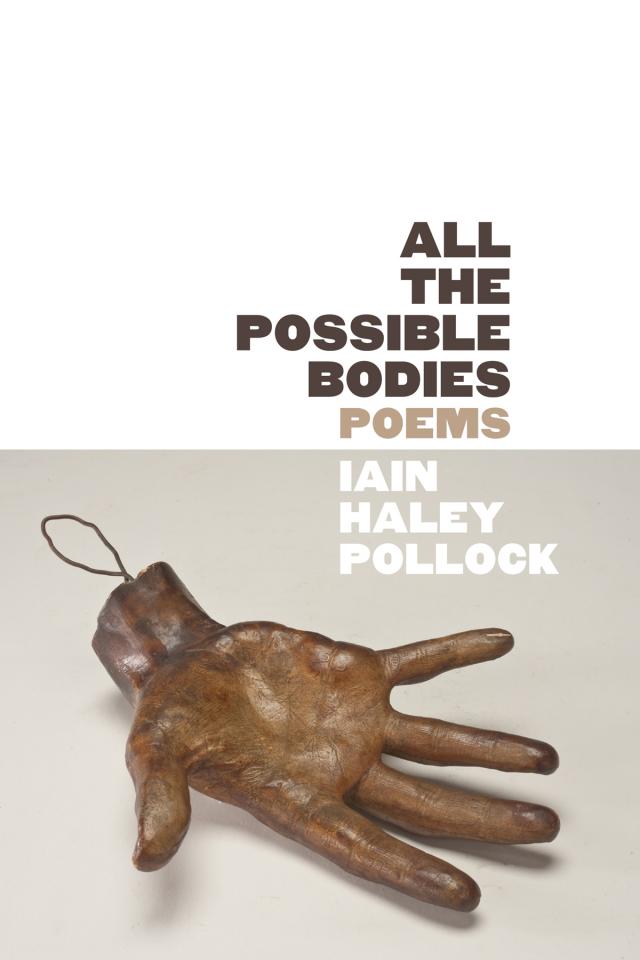
ALL
THE
POSSIBLE
BODIES
POEMS
IAIN
HALEY
POLLOCK
© 2025 by Iain Haley Pollock
All rights reserved
Printed in the United States
10 9 8 7 6 5 4 3 2 1
Alice James Books are published by Alice James Poetry Cooperative, Inc.
Alice James Books
Auburn Hall
60 Pineland Drive, Suite 206
New Gloucester, ME 04260
www.alicejamesbooks.org
Library of Congress Cataloging-in-Publication Data
Names: Pollock, Iain Haley, author.
Title: All the possible bodies : poems / Iain Haley Pollock.
Other titles: All the possible bodies (Compilation)
Description: New Gloucester, Maine : Alice James Books, 2025.
Identifiers: LCCN 2025006526 (print) | LCCN 2025006527 (ebook) ISBN 9781949944907 (trade paperback) | ISBN 9781949944488 (epub)
Subjects: LCGFT: Poetry.
Classification: LCC PS3616.O5696 A78 2025 (print) | LCC PS3616.O5696 (ebook) DDC 811/.6—dc23/eng/20250325
LC record available at https://lccn.loc.gov/2025006526
LC ebook record available at https://lccn.loc.gov/2025006527
Alice James Books gratefully acknowledges support from individual donors, private foundations, the National Endowment for the Arts, and the Poetry Foundation (https://www.poetryfoundation.org).
Cover: “Eakins Hand” by Samuel Murray (c. 1894). Hirshhorn Museum and Sculpture Garden, Smithsonian Institution, Washington, DC, Gift of Joseph H. Hirshhorn, 1966
CONTENTS
1. AMERICA,
A Black Mother’s Child Considers His Lost Dream of Immortality
Metaphysics with Poppies
Weighing Death by Patricide (on the Old Croton Aqueduct Trail)
All the Possible Bodies
2. IS YOU IS
These Moral Currents Cut
Lady Soul
Deep Down, Every Sinner
Selfhood Among Nationhood: Mythic Imperatives
Is You Is, or Is You Ain’t? (An Answer Becomes a Set of Further Questions)
Romanticized Portrait of My Self-Loathing as the Poleman in Eakins’s Rail Shooting on the Delaware, Also Known as Will Schuster and Blackman Going Shooting (1876)
Abrupt Edge
3. OF MARKS & LACKS
4. ARTIFACTS
Turn, hell-hound, turn!
Horace Silver Hexagonal Blues
Subject of My Desire (In Which You Do Not Figure)
Artifacts
[Weather of summer and weekend blur]
Not a Prayerful Kneeling (for John Lewis)
for I think upon the price of my redemption
On a Different Day
5. MYTHOLOGIES OF THE SUBURBS
These and all else were to me the same as they are to you
The Dismantling of Moscow’s Bells
Lessons Ending in Allegheny Plum
Notes Toward My Younger Boy’s Possible Biographies of Me
On Black Quarterbacks & Dogfights in Virginia Woods
Ward Pound Ridge
Mythologies of the Suburbs
In Some America / a Gun
6. RENDERS ITSELF VISIBLE IN MY BODY
Heron and Light at the Croton River
Frequency & Amplitude: the Child / Sing
Danse Printemps et Quarantaine
Notes on the Poems
Acknowledgments
FOR TERRENCE D. WILLIAMS & DAVID B. EYE
1. AMERICA,
A BLACK MOTHER’S CHILD CONSIDERS HIS LOST DREAM OF IMMORTALITY
I.
What was she hoping I’d learn? What lessons
when my mother, who taught Greek
at the college on the hill, read their old stories
to me? To be ready one night for hooded snakes
to crawl into my cradle? To leave a trail of twine
behind me as I walked the labyrinthine corridors
of my country? Not to raise the wrong sail
whenever I came home to her? Not to dive
as the swan and plummet into a woman bathing
in the seclusion of high reeds, not to be the shock
and awe of white wings? For me though, the truth
in the myth was this: power transforms
into life, and life forever. And when my mother
was finished, all I wanted was to live
as those changing but unchanging gods.
II.
The White man who taught me Greek
hated me. He thought I was lazy. I admit
that I often slept through his morning class,
often stumbled through his translations as a boar
through deep, sudden snow. My mother cried when
she left me in the parking lot of that place. Cried
harder than I’d seen since the week after her father
died. I think she had learned that no Black mother
can save her children. Save them, as you have proven
(and are still proving), America, from your primitive,
bullhorned violence. And so, more days than not,
her son stood beside an aluminum keg, fermenting
himself, pouring into his gullet a river,
not of forgetfulness, but of an urgent forgetting.
III.
My mother wanted to learn Latin on her way
to Greek, but the teachers had her pegged
to cook and sew. Short but thickset,
the school’s own former football hero, her father
traded on his glory, the scars earned for it,
on his hobbled knees, the slight slur of his speech
to demand a place for her in a room of primers
and chalkboards. They thought she should scurry
about the rooms of your house, America, picking up
what you had dropped. But she overcame to stand
at the front of a room, professor of language
and myth. I told a version of this story to Black children
at a school in Philadelphia. When I came to the end—
my mother teaching Greek at the college on the hill—
they rose from their chairs and applauded her
through the proxy of me. I think now I lied to them.
Lied to them while standing in a room across town
from where you firebombed a city block to save
yourself. America, you have eaten your children
to keep your place on the honeyed mountaintop.
If you have not already, you will consume these children
too. And still you will come, with wild, ravenous hunger,
for more. And why do you keep doing what you do?
And what will you do one day when, instead of a child,
you swallow a stone?
METAPHYSICS WITH POPPIES
I can’t understand, after years of reading, the relevance
of metaphysics. How does it account for the wants of my mind
breaking apart my body? I prefer to think of poppies,
the variety fated to bloom blood-red. Or, of planting poppies,
any flowers in truth—how they come to us in plastic pots; how
after we shovel them a place in the earth, we extract
the flowers from their vessels; how while we lower them down
into their potting hole, ganglionated roots and the dirt compacted
around those roots retain the container’s shape. I am interested
in the shape of things. Is that the relevance of metaphysics?
You know I’m hiding again, don’t you? Still the boy
between the cedar and the wedge of stone wall where, lying flat,
he cannot be seen from the first house his parents ever owned.
I am hiding because I am tired of broken promises,
my country’s and my own. I thought we promised never again
to clothe bodies, especially of children, in chain link.
But here we are. And me, I promised to jettison the anger
that howls away at those, especially the children, I mean to keep
closest to me. But here we are, anger not exorcized,
stashed instead on a high shelf, loaded and with the safety off.
I need that anger—brandishing it I feel most electric and alive.
That’s not quite it, but I cannot make the story only about me:
we would not let a woman and a man and their sons
walk across a bridge. Or, if we had, when they arrived,
we would have outfitted the boys in that broken promise
of fence. I can’t understand what we feared. Maybe
that we’d fall out of love with a country that never was
as we imagined it? Maybe that we’d fall out of love
with ourselves? The sons gathered between the woman
and the man, the four hitched arms and waded
into the water we’ve decided separates that place from
this place. As the four experienced it, swollen and churning
with a confluence of spring rain, the river was both abstract
and real. You know the resolution: water suddenly high,
wrench of undercurrent, the boys drowned. The first son
washed into a backwater matted green with reeds eroded
to the other side, the second son floated to something like rest,
soda cans bobbed with him in the shallows. As the mother
and the father could not, I am afraid that I cannot protect
my children. I use anger to keep myself, and them, alive.
This is wrong. I am wrong also to make the story of the woman
and the man and their sons about me. I made a different promise
never to masquerade in stories not my own. But I hid behind them,
their story, as I hid behind metaphysics, poppies, anger, a cedar,
and fear. I hope it matters, although I suspect it doesn’t,
that I broke this promise in good faith: their story
is not my story, but if I don’t see myself in them—the four
in the water and not on the bridge—what do I stand
in relation to? what are my properties? what shape am I in?
WEIGHING DEATH BY PATRICIDE (ON THE OLD CROTON AQUEDUCT TRAIL)
When, this spring, the virus shut us in,
the older boy and I
wore each other mean—
the friction of father and son heightened
by all around us the spidering sense
of sickness. I was glad the bitterness
between us went unseen
behind our house’s heavy, paneled door.
Summer today, and the city and towns here
less ravaged, we walk again
in the open world. The older boy
has broken off the homeward
hike from the berm where
the old aqueduct once ran.
He has climbed onto a white-hickory trunk
fallen by the trail’s side and walked its length
to stand near the root ball,
deracinated and dangling in the air.
Balancing, he spears
a sharp-pronged stick
into the tree’s decomposition,
each jab kicking up
a spray of softened wood.
The younger boy stays closer
to the trail and me, content
to peel away thick swaths
of diamond-furrowed bark.
He beams in triumph as he holds up
larger and larger strips, trophies
for me to see. Should I be disturbed
by their destruction? Their joy in it? Their zeal?
These last few weeks they’ve been scaring me.
In their waking dreams of patricide,
I’ve died a dozen gory deaths: every stick
a bayonet to thrust into my back,
every thumb the hammer to a six-shooter unloading
its cylinders into my chest, every upper-story window
an invitation to my body’s forced fall,
every rock a grenade to send shrapnel
under my skin in search of organ
and bone. I’m grateful, in this moment,
to let the downed white hickory entertain
their latent violence. While the older boy’s head
stays lowered and he stabs at the trunk,
the younger trots my way pinching a millipede.
He leads me to where he found it—
a slow riot of arthropods crawling
on the hickory’s exposed wood, feeding there
on fungi, first cause of this decay.
I should not fear a sharp death,
homemade knives shivved
into a heaving sack of lung.
I should fear some death more like this:
a boy turned from me
who won’t turn back
while the thousand-footed failings
I never wanted seen
work steadily
under the bark
and ravage me away.
ALL THE POSSIBLE BODIES
My alcoholic grandfather couldn’t hold his money
& passed a bad check. Hampton / Virginia / after Brown
v. Board but before Selma’s Bloody Sunday. After
my grandmother died but before he moved the family
North / back to the town of his birth. My mother saw
her father cuffed & dragged from the house. The next
day / by some miracle she never understood /
he came home.
Had he looked at the officers wrong /
acted wrong / spoken wrong / been too familiar / been
a few inches taller / been deeper voiced or darker skinned
& for this had he caught a knee that night to the neck
& not returned / perhaps my mother / needing to stay home
& raise Aunt Joan & Uncle Keith / would have skipped
college. Had she skipped college / perhaps she would not
have gone for a Ph.D. Had she not gone for a Ph.D. /
perhaps she would not have met my father. Had she
not met my father / perhaps I would not be here /
perhaps the boys sleeping upstairs from me now
would not be here.
When you spend 8 minutes & 46 seconds / with your knee /
on another man’s neck /
you block not just the passage
of air / into his body / but block air into all the possible
bodies / dependent on that man /
& his neck / to breathe / breathe / breathe /
breathe / breathe—
2. IS YOU IS
THESE MORAL CURRENTS CUT
Half my bad childhood racial memories happened
at middle-school dances. The blond boy who snatched
the fresh Malcolm X hat off my head, threw it down
into a dance floor mess of fruit punch & gritty footprints,
& told me you’re not black—stop pretending. (Entire careers
made of upholding that line when we refuse to run patrol
for them.) At another dance, I was ringed by leering
white faces that belted out, It don’t matter if you’re black
or white. I wasn’t sure what those faces meant, but I knew
they meant to hurt. I’ve never held that lyric against Michael
Jackson. I do find, though, listening to his old albums,
those Jackson 5 records with cuts like “Never Can Say
Goodbye,” has gotten hard. These days I know how that story
ends: the descent into dysmorphic madness, the predatory
doors bolted & shut behind boys, one stolen childhood
thieving another. My better angels think it’s wrong
to separate the art from the artist. I hated learning
Pound in school when we all knew he was a fascist
& anti-Semite. He should have stayed locked
in the gorilla cage of his hate. But then I admit Miles Davis
has lodged brass notes irrevocably under my fifth rib,
& some of those notes he bent while blacking & bluing
Cicely Tyson. (Cicely goddamn Tyson . . .) & on the night MJ
died, I danced to his music in a circle of dancers until my shirt
was sweat-stuck to my chest, until I stank with grief.
I didn’t know then all that disgusts me now—the doors,
the boys—but the hard truth is: if the King of Pop died today,
I don’t think I could stop myself from letting hips sway
to music that, especially in the writhing all-night body rock
of a house party but even in my mother’s halting soprano,
pushes past joy to abandon. These moral currents cut the other
way too: the blond boy who snatched the X hat off my head,
when a young man, walked into a gas-station store to find a woman
being beaten by her boyfriend & when the blond boy went to stop
him, the boyfriend ignited a lighter & touched it to the boy’s shirt,
which burned until it curled into a sneer & then stuck to his white skin.
LADY SOUL
How easy, driving the White Mountains—
sundown, three beers deep—to hold
the wheel steady and become a tangent,
jump the banked asphalt, rip through
the guardrail, to give over to gravity,
let it drag you down into a birch trunk
or a glacial erratic’s weathered granite.
They’d blame the wreck on alcohol or
your ignorance of the road or the severity
of the curve.
But before you left the bar
in Plymouth, you queued her on the car stereo,
a combustion internal and holy revving in her voice.
As you drive, sunset hazes around the peaks,






