

Doctor dolittle and the.., p.1
Doctor Dolittle and the Green Canary, page 1
part #11 of Doctor Dolittle Series


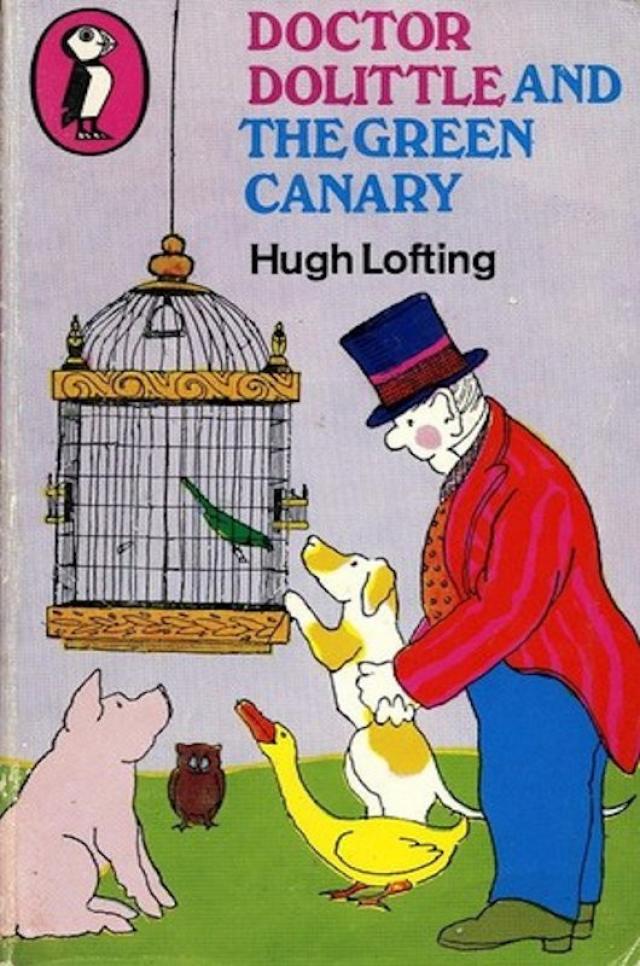
Doctor Dolittle and the Green Canary
by:
Hugh Lofting
IF you have ever read _Doctor Dolittle’s Caravan_ you will remember Pippinella, the green canary—half canary, half greenfinch—whom Doctor Dolittle had bought from a pet shop, and how she became the prima donna of his opera company.
In the evenings she told such fascinating stories about her life that the Doctor said, ‘You’re a born story-teller, Pippinella. Would you be willing to help me write your biography?’
Of course, Pippinella was delighted to help, so evening after evening she related her experiences and the Doctor wrote them down, and all the animals listened with great attention—except Gub-Gub, who sometimes interrupted. They heard how she had lived in a wicked marquis’s castle, worked as an air tester in a coal mine and flown to an uninhabited island, and all about her owners, from kind, silly Aunt Rosie to the best of all, a lonely window-cleaner who wrote books.
Pippinella brought her story right up to date, so then all it needed was a happy ending. Fortunate as she considered herself in joining the Dolittle household, she still longed to know what had become of her best master, the kind window-cleaner, for after many adventures and many happy days, they had been cruelly separated, and now she had no idea whether he was alive or dead. So once again Doctor Dolittle put off returning to his dear old home in Puddleby, to search for Pippinella’s friend.
Table of Contents
Doctor Dolittle and the Green Canary
CONTENTS
FORWARD
PART ONE
1 - THE DOCTOR MEETS THE GREEN CANARY
2 - THE INN OF THE SEVEN SEAS
3 - AT THE MARQUIS’S CASTLE
4 - THE RESCUE
5 - THE MIDGET MASCOT
6 - THE FORTUNES OF WAR
7 - THE COAL-MINE
8 - Aunt ROSIE’S HOUSE
9 - THE OLD WINDMILL
PART TWO
1 - THE GREEN CANARY LEARNS TO FLY
2 - NIPPIT, THE GREENFINCH
3 - EBONY ISLAND
4 - PIPPINELLA FINDS A CLUE
5 - THE WINDOW-CLEANER AT LAST!
6 - THE WINDOW-CLEANER’S ADVENTURES
7 - THE RAGGED TRAMP
PART THREE
1 - THE CANARY OPERA
2 - THE GREEN PARROT HAS A CLUE
3 - CHEAPSIDE HELPS THE DOCTOR
4 - JOHN DOLITTLE, M.D.
5 - THE WINDOW-CLEANER TELLS HIS NAME
6 - THE SEARCH FOR THE MISSING PAPERS
7 - THE SECRET HIDING PLACE
8 - THE THIEF ESCAPES
9 - THE RUNAWAY COACH
10 - THE PAPERS RECOVERED—AND PUDDLEBY AGAIN
THE END
FOREWORD
When my husband, Hugh Lofting, wrote and illustrated this story of Pippinella, the green canary, for the New York Herald Tribune his intention was some day to publish the material in book form. Towards this end he wrote _Doctor Dolittle’s Caravan_, in which the little canary appeared as the prima donna of the Doctor’s canary opera and became a well-loved and established member of the Doctor’s household. However, by the time the _Caravan_ was ended, Mr Lofting found so much of Pippinella’s story still untold that he began to work on another book to include all the exciting adventures which had befallen the Doctor’s little friend before she joined the caravan. He also found that he had to tell the many readers, who wrote and requested further knowledge of this unique little bird, how the Doctor and his family helped to bring her tragic life story to a happy conclusion.
It was never finished. But so near had Mr Lofting come to doing so that I felt I must find a way to do it for him. When my sister, Olga Michael, whose inclination to write had been applauded and encouraged by my husband, and who had helped him during the compiling of the new material for Pippinella, offered to finish it, I and the publishers were delighted.
And so, here it is; the completed story of the green canary with only a brief first chapter to introduce the Doctor and his family to new readers and a dramatic and exciting conclusion to round out the life of the unusual little bird, Pippinella. I believe my husband would have approved.
JOSEPHINE LOFTING
PART ONE
1 - THE DOCTOR MEETS THE GREEN CANARY
THIS story of the further adventures of Pippinella, the green canary, begins during the time of the Dolittle Circus. It will tell—in much greater detail—the strange events which took place in the life of the little bird before she came to live with John Dolittle.
Pippinella was a rare kind of canary which the Doctor had found in an animal shop while taking a walk with Matthew Mugg, the Cats’-Meat-Man. Thinking he had made a bad bargain because—as he thought—hen canaries couldn’t sing, he had been greatly astonished, on getting her back to the caravan, to find she had a most unusual mezzo-contralto voice.
And what was more unusual still, she had travelled many thousands of miles and lived a most varied and interesting life. When she had told the Doctor some of the dramatic happenings which led up to her being sold to the animal shop he interrupted her to say:
‘You know, Pippinella, for many years now, I have wanted to do a series of animal biographies. But, because most birds and animals have such poor memories for details, I have never been able to get on to paper a complete record of any one animal. However, you seem to be different—to have the knack for remembering the proper things. You’re a born story-teller. Would you be willing to help me write your biography?’
‘Why, certainly, Doctor,’ replied Pippinella. ‘When would you like to begin?’
‘Any time you feel rested enough,’ said the Doctor. ‘I’ll have Too-Too fetch some extra notebooks from the storage tent. How about tomorrow evening after the circus is closed up for the night?’
‘All right,’ said the canary. ‘I’ll be harry to begin tomorrow. I _am_ rather tired tonight; this has been a most trying day. You know, Doctor Dolittle, for a few moments this afternoon I was afraid you were going to pass right by that dreadful shop and leave me there.’
‘Indeed, I might have,’ said John Dolittle, ‘if your cage hadn’t been hanging in the window where I could see how disappointed you looked as I began to move away.’
‘Thank heaven you came back!’ sighed Pippinella. ‘I don’t know how I could have borne another moment in that dirty shop.’
‘Well,’ said the Doctor, ‘that’s all over now. I hope you’ll be very happy with us. We live quite simply here—as you can see. These animals and birds I call my family, and—for the time being—this wagon is our home. One day when we have had enough of circus life, you shall return to Puddleby with us. There you will find life a great deal quieter—but pleasant just the same.’
This conversation, which the Doctor had with the green canary, was all carried on in the bird’s own language. You will remember—from previous stories about John Dolittle and his animal family—that he had learned, many years before, to speak the language of animals and birds. This unique ability had earned for him the friendship and loyalty of all living creatures and had influenced him to change his doctoring of humans to a busy life of caring for the illnesses and injuries of animals, fish and birds.
While the Doctor was talking with the Pippinella about writing her biography, the members of his household had withdrawn to a corner of the wagon and were carrying on a lively discussion. Gub-Gub, the pig, as well as Dab-Dab, the duck, Jip, the dog, and Too-Too, the owl, were quite indignant that the Doctor should choose a newcomer to the group for this great honour. Whitey, the white mouse, being more timid than the others, just listened and thought about the idea. But Gub-Gub, the most conceited of the lot, said that he was going to speak to the Doctor about it.
So the next evening, when the family had gathered in the wagon to hear the continuation of the canary’s story, Gub-Gub cleared his throat nervously and spoke up.
‘I don’t see why anyone would want to read the biography of a mere canary,’ he grumbled. ‘My life is much more interesting. Why, the places I’ve been! Africa, Asia, and the Fiji Islands. Not to mention the food I’ve eaten. I’m a celebrity for that if for nothing else. Now, what can a canary know about food—eating nothing but dried-up seeds and bread-crumbs? And where could she go—cooped up in a cage most of her life?’
‘Food! Food! That’s all you think about,’ snapped Too-Too. ‘I think it’s more important to be a good mathematician. Take me, for instance; I know to the penny how much gold there is in the Bank of England!’
‘I have a gold collar from a king,’ said Jip. ‘That’s something!’
‘I suppose it’s nothing that I can make a bed so it’s fit for decent folk to sleep in!’ snapped Dab-Dab. ‘And who, I’d like to know, keeps you all healthy and well fed. I think that’s more important!’
Whitey just sat there and didn’t say a word; he didn’t really think his life was interesting enough for a biography. When the Doctor looked at him with a questioning expression on his face Whitey dropped his eyelids and pretended to be asleep.
‘Haven’t _you_ anything to say, Whitey?’ asked the Doctor.
‘No, sir—I mean, yes!’ said the white mouse timidly. ‘I think the biography of Pippinella will be very nice.’
‘Well, let’s get on with it, then,’ said the Doctor. ‘Please—if you’re ready—we are, Pippinella.’
The canary then told them how she was born in an aviary—a
Pippinella explained that it was not true—that hens could not sing as well as cocks. It was only that cocks did not encourage their womenfolk to sing, saying that a woman’s job was to care for and to feed the young, and to make a home for her husband and children.
It was because of her beautiful voice that Pippinella finally acquired a master who bought her and carried her off to a new home; an inn where travellers from all over the world stopped on their way to the seaport to eat and sleep the night.
After the canary had described the inn more fully the Doctor interrupted her to ask:
‘Pardon me, Pippinella. Could that have been the Inn on the road from London to Liverpool?—I believe it is called _The Inn of The Seven Seas_.’
‘That’s the one, Doctor,’ answered the little bird. ‘Have you been there?’
‘Indeed we have,’ replied John Dolittle, ‘several times.’
Gub-Gub jumped up so suddenly from his chair that he crashed into the table where Pippinella sat telling her story and sent the water out of the canary’s drinking dish sloshing over the sides.
‘I remember!’ he cried. ‘That’s where the turnips were especially good—done with a parsley sauce and a little dash of nutmeg.’
‘If I’m not mistaken,’ said Jip. ‘I felt a perfectly good knuckle-bone buried there. Cook gave it to me right after dinner and I planned to eat it later. But the Doctor was in such a hurry to move on I hadn’t a moment to dig it up before we left.’
‘I’ll bet you wished many times that you had it, eh, Jip?’ said Too-Too. ‘But then, you must have had plenty of bones buried back at Puddleby.’
‘Not more than three or four,’ Jip replied. ‘Those were lean days.’
‘They would have been leaner if I’d not found that gold sovereign just as we were leaving,’ piped up Whitey.
‘Gold sovereign?’ asked the Doctor. ‘You didn’t tell me about it. Whatever did you do with it, Whitey?’
Whitey looked confused and kept glancing from Dab-Dab back to the Doctor. He wished he’d kept quiet about the sovereign.
Dab-Dab ruffled her feathers and made a clucking noise.
‘He gave it to me. John Dolittle!’ she said crossly. ‘How do you think we would have eaten at all after that scoundrel, Blossom, departed with all the circus funds? You know our larder was empty, Doctor. Except for about a tea-spoonful of tea and some mouldy tapioca.’
‘But the sovereign didn’t belong to you,’ said the Doctor.
‘It did—just as much as to anyone else,’ said Whitey. ‘It was lying in the dust right smack between the hind feet of one of the coach horses. And he was trampling and kicking up the dirt so that I could hardly keep my eyes on it—good as they are.’
‘No one but Whitey—with his microscopic eyes—would ever have seen it,’ said Dab-Dab. ‘There was no point in running around asking stable-boys and kitchen-maids if it belonged to them. Who could recognize a gold sovereign as his? Anyway, it’s spent now—that was almost a year ago.’
‘Well, well,’ sighed the doctor. ‘I suppose it was all right. Shall we get on with the story, Pippinella?’
‘I was treated with great respect and admiration by the owner of the inn and his wife and children,’ continued the canary. ‘And I made many friends there. Everybody stopped to speak to me and listen to my songs—it was very gratifying.
‘The coming and going of coaches from all directions, and the busy, cheerful people who worked for my master, inspired me with no end of ideas for new songs. It was a wonderful place for composing!
‘On nice days my master would hang my cage on a hook high up beside the entrance to the inn. There I would greet the incoming guests with my very best songs. One little verse I made up and set to music became very popular with everyone who heard it. I called it “_Maids, come out, the coach is here,_” and whenever I heard the sound of approaching horses I’d sing it at the top of my lungs to announce to the stable-boys and porters that another coach-load of travellers was nearing the inn.
‘Among the people who came to be my friends was one named Jack, who drove the night coach from the North. For him I composed a merry tune called “_The Harness Jingle Song_”. Old Jack would call out to me, as he rolled his coach into the noisy courtyard, “Hulloa, there Pip! Hulloa!” and I’d answer him by singing another verse of his song.’
2 - THE INN OF THE SEVEN SEAS
AFTER a short pause in which the green canary seemed to be lost in thought she continued her story.
‘Besides the many friends that I made among the people in that place I made lots more among the animals. I knew all the coach horses and I would hail them by names as they came trotting into the yard. And dog friends I had too: the watchdog who lived in a kennel by the gate and several terriers who hung about the stables. They knew all the local gossip of the town. There was a dovecote above the loft where they kept the hay for the horses. And here carrier pigeons lived who were trained to fly long distances with messages. And many were the interesting tales that they could tell of an evening, when they sat on the gutters of the roof or strutted about the yard beneath my cage, picking up the bits of corn that had fallen from the horses’ nosebags.
‘Yes, as I look back over all the places I have been, that nice, busy old inn seems as good a home as any cage bird could wish to find.
‘I had been there, I suppose, about five months when, just as the poplars were beginning to turn yellow, I noticed a peculiar thing: knots of people used to gather in the yard of an evening and talk with serious, worried faces. I listened to such conversations as were near enough for me to hear. But although I knew by this time the meaning of a great number of human words I couldn’t make anything out of this talk. It seemed to be mostly about what you call politics. There was an air of restlessness. Everybody seemed to be expecting or fearing something.
‘And then one day for the first time I saw soldiers. They came tramping into the inn yard in the morning. They had heavy packs on their backs. Evidently they had been marching all night, because many of them were so weary that they sat down against the stable wall with their boots covered with dust, and slept. They stayed with us till the following day, eating their meals in the yard out of little tin dishes which they took from the packs they had carried.
‘Some of them had friends among the maids of the inn. And when they left I noticed that two of the maids who waved to them from the dining-room window were weeping. There was quite a crowd to see them go off. And very smart they looked in their red coats, marching out of the gate in rows of four with their guns on their shoulders and their packs on their backs, stepping in time to the drummer’s _rap—rap, rappatap, tap, tap!_
‘Not many days after they had gone we had another new kind of excitement, another army. But this one did not wear smart uniforms or march to the beat of a drum. It was composed of ragged people, wild-eyed, untidy and disorderly! They came scrambling into the inn yard, shouting and waving sticks. A leader among them stood on an upturned bucket and made them a speech. The owner of the inn begged the leader to take them away. He was evidently very worried about having them in his yard. But the leader wouldn’t listen. When one speech was finished another would begin. But what any of them was about I couldn’t make out.
‘Finally the ragged mob drifted away of its own accord. And as soon as the yard was clear the innkeeper shut and locked the gate so they couldn’t come back.
‘I asked one of my pigeon friends what it all meant. He shook his head seriously:
‘“I don’t quite know,” he said. “Something’s been going on for weeks now. I hope it isn’t war. Two of the carriers, the best flyers in the dovecote, were taken away last Monday. We don’t know where they went to. But those two pigeons were used for carrying war messages before.”






