The last enemy, p.1
The Last Enemy, page 1


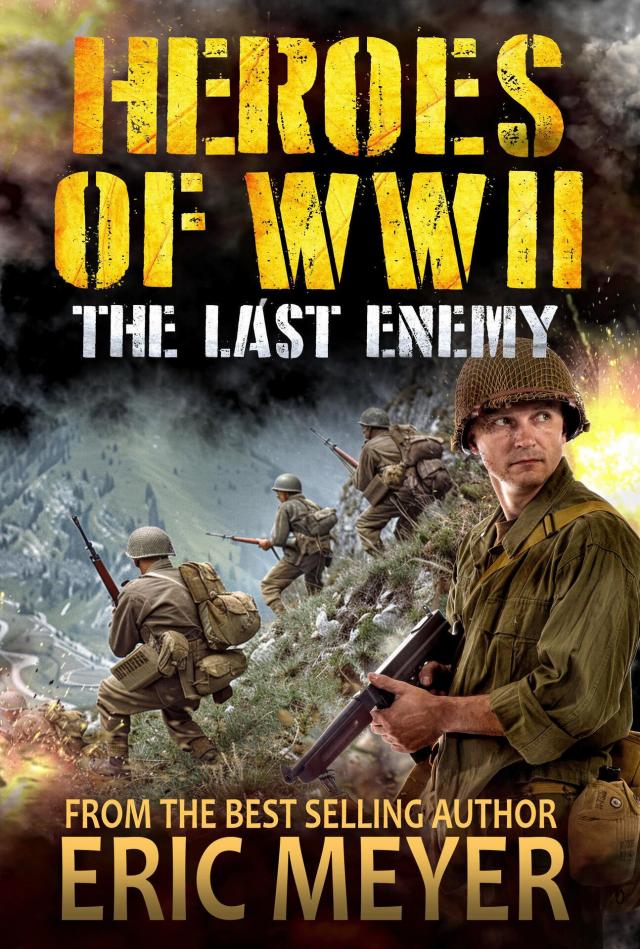
MURPHY’S RANGERS IX
The Last Enemy
HEROES OF WORLD WAR II
Eric Meyer
Copyright 2024 by Eric Meyer
Published by Swordworks Books
All rights reserved. Without limiting the rights under copyright reserved above, no part of this publication may be reproduced, stored in, or introduced into a retrieval system, or transmitted, in any form, or by any means (electronic, mechanical, photocopying, recording, or otherwise) without the prior written permission of both the copyright owner and the above publisher of this book.
This is a work of fiction. Names, characters, places, brands, media, and incidents are either the product of the author’s imagination or are used fictitiously. The author acknowledges the trademarked status and trademark owners of various products referenced in this work of fiction, which have been used without permission. The publication/use of these trademarks is not authorized, associated with, or sponsored by the trademark owners.
MY NEWSLETTER
If you’d like to receive my latest news, special offers, and free books then please sign up for my newsletter. It’s a great way of keeping up to date with my latest projects, as well as getting samples and free books throughout the year. Click on the link and join up today. You can also visit my official website and Facebook page, links below:
My official newsletter
My official website
My Facebook Page
PROLOGUE
Budapest, February 1945
The thunder of the Soviet artillery, the crash of exploding shells, and the constant noise of falling masonry were a living nightmare. Every man in the beleaguered Hungarian capital of Budapest knew the end would come soon, probably within hours. The SS officer waited, crouched in a hastily dug trench at the edge of an improvised airstrip. The ground crews were hurrying to refuel the squadron of nine fighters that’d landed less than an hour before. Fuel was scarce, and Luftwaffe personnel had scoured the surrounding area to round up every gallon they could lay their hands on.
The aircraft were sorely needed to defend against the onrushing armada of Russian fighters and bombers constantly attacking the city night and day. The death and destruction never ended, and the last few defenders skulked in basements while they waited for the end. Yet these aircraft had been assigned to a different task. A mission back to the Reich to escort a single man. SS-Obergruppenführer Dr. Karl-Heinz Richter, a world-renowned physicist, right now regarded by Berlin as the most important man in the Third Reich.
Richter had been sent to Budapest to search for and interrogate a Hungarian scientist, Paul Laszlo, who’d disappeared. The scientist had made no secret of his admiration for Soviet Communism, nor his dislike of National Socialism. Berlin assumed he was planning to offer his services to the Russians when they took the city. He’d searched everywhere and finally discovered Laszlo’s body in the wreckage of a bombed-out building. The mission ended with his death, and that was two days ago. They’d recalled urgently him to the Reich before it was too late. His task was to complete the construction of a new weapon, a device of incredible power being developed in an underground laboratory close to Nordhausen.
Richter was alone in the trench. Men kept out of the way of this formidable SS-General, known to have powerful connections in Berlin. He was a fleshy man, with a pronounced paunch and a face set in a perpetual frown of haughty disapproval. His pale, pudgy face was that of a man who’d spent his adult life indoors, working in brightly lit laboratories and research facilities. Spending the past few days in the besieged cauldron of Budapest had made him almost unrecognizable to those who’d known him previously. His chin showed several days of beard growth, and his uniform was disheveled and covered in dirt and dust. The city under heavy Russian fire had few facilities for men to carry out their normal ablutions.
Despite his non-military background, he hadn’t entirely escaped the fighting, and his face betrayed two scars, one on his forehead and the other a deep gouge that crossed his face from the corner of his mouth to his right ear. The scar on his forehead resulted from a shell fragment that came too close, and the scar on his cheek the product of a Russian sniper. The harassed doctor who’d worked non-stop for three days without sleep or rest yet rushed to attend to his wounds received no thanks.
Richter’s demeanor was cold and calculating, a man who’d never experienced or shown anybody the tiniest amount of empathy or compassion. His overwhelming and sole determination was to complete his work. And to see the Third Reich achieve total victory over its enemies.
During a temporary cessation of the bombing and incoming fire, a pilot jumped into his trench and told him they were ready to leave. “You need to be quick, Sir. The Russians will start any second.”
“My Junkers Ju-52 has arrived?”
“No, Sir. It was shot down. You will travel in one of our fighters.”
He snorted in disgust. “Those aircraft are single-seat, they do not have room for passengers.”
“I have a Messerschmidt 110, a two-seater. It’s slower than the Fokke Wulf 190s, but they’ll stay with you and escort you all the way. But we need to go now.”
He followed him onto the strip. The man helped him into the co-pilot’s seat of the ME-110 and fastened his straps. The other pilots were climbing into their aircraft, and he noticed that every man looked pale and apprehensive. Like they were going to their deaths. They also looked very young. They’d be recent recruits, thrown into battle after minimal training in a desperate attempt to stem the Soviet tide.
The man seated himself in the cockpit, started both engines and waved to the ground crew to get clear. Without pausing for pre-flight checks, he pushed the throttles all the way forward, the Messerschmidt gathered speed and climbed into the air. Richter noticed two FW-190s take off at the same time and take up station on either side. They were followed by the other six fighters. They didn’t climb far. Leveled off at no more than one hundred feet, skimming across the wrecked landscape. Within minutes, the Russians pounced.
At least a dozen Yak-3 single-seat fighters, fast and capable. The pilots were good, having been in action against the Luftwaffe as the Red Army rolled westward. The escort fighters engaged them, desperately trying to keep them away from the ME-110, but the odds against them were overwhelming. The enemy had no shortage of fuel, no shortage of ammunition, and no shortage of skill learned in battling their severely weakened enemy. One by one, the FW-190s were shot out of the sky. The last almost made it across the German border, but a lone MiG-3 pounced from a thick patch of clouds and shot it down with a long, raking burst from its Berezin UB heavy caliber machine gun.
The pilot of the ME-110 dropped the nose and flew almost at ground level. Within an hour, they made a bumpy landing on a road they’d cleared for the purpose outside Nordhausen. A squad of heavily armed SS rushed out and surrounded the aircraft, forming a ring around Richter as he emerged. They escorted him to a waiting Kubelwagen, two half-tracks, the lightly armored vehicles manufactured by Hanomag to carry infantry and two artillery pieces. Both Hanomags were crammed with heavily armed soldiers, and they fell in ahead and behind the jeep. They drove for three miles, stopping only to wait out a bombing raid over the town, and sped down a ramp that led to his new post, a labyrinth of underground tunnels.
He didn’t waste time. Summoned the senior staff and informed them he was there to take charge. They led him to the main laboratory, the ‘holy of holies.’ A spacious, well-lit cavern, and in the center was the device he’d come for, close to completion.
A scientist explained they’d constructed two devices, but moved the other to a different location, a well-hidden mirror facility, in case the Allies overran Nordhausen before completion. For the first time since leaving Budapest, he smiled. This would change everything. Nothing would be the same again.
* * *
Nordhausen, Germany, April 1945
He glanced fearfully at the guard, and the soldier stared back at him with an implacable, hard gaze. He was always there at the entrance to the laboratory, standing motionless, MP-40 machine pistol slung in front of his chest. His eyes were as hard as his steel helmet. The laboratory was well-lit with power provided by a gasoline generator housed in a separate cavern several hundred yards away. Good lighting was essential for their work to continue. Vital work for the survival of the Reich. But not for him. For the thousandth time, Konrad Neuberg considered how he could carry out an act of sabotage. A minor mistake in his calculations or a misplaced component during the assembly process, and this entire underground complex would become a death trap.
He was almost unique in Nazi Germany. A live Jew, one of the few not loaded into cattle cars and transported east. They’d allowed him to live because he had a skill the Germans valued more than any other at this late stage of the war. The Soviets were massed on the eastern side of the Reich, advancing toward Berlin, and the American and British armies in the west. The war was lost unless a miracle occurred. Like the miracle, they’d forced him to work on inside this laboratory built deep underground. Close to Nordhausen, on the northern edge of the Harz Mountains.
The invasion of Western Europe and constant Allied bombing had destroyed or overrun many V2 rocket sites, so they’d moved them further away, beyond the reach of the invading armies. The previous year they’d also moved this laboratory from the outskirts of Berlin, ravaged by day and night bombing, into this facility, safe from air attacks. The operation had required stripping precious resources and personnel from both East and Western fron
So far, he’d managed to keep his notes hidden, but his boss, the senior SS officer who two months ago had taken command of the underground project, was suspicious. He’d questioned him several times about where he’d written everything down. Each time he denied making notes. Notes he’d secreted behind a timber panel next to his bunk. He was determined to get them to the Americans and the British. Somehow. If the Nazis discovered he’d made such an important breakthrough and they got hold of his notes, it would be a catastrophe. Then there were the Soviets. If they reached Nordhausen first before the Americans, it could be almost as bad. He had to get those notes to the West. Had to sabotage the project.
He glanced again at the guard, who stared implacably back. Never took his eyes off him. He cast his eyes down at his bench, checking the instruments, about to run another test that he knew would fail. He switched on the equipment and ensured the readings were optimal. As long as they never learned what he’d achieved, Germany must lose the war. In the meantime, he would continue to waste time and precious resources on yet more failures.
“Turn it off!”
His hand automatically reached for the switch and the machine went silent. He sat and waited while the man he feared most, Dr. Karl-Heinz Richter, approached. Richter held the honorary SS rank of Obergruppenführer, and that made him the most senior officer at Nordhausen. A celebrated physicist, he was almost as skilled as Neuberg. He was also a killer, prepared to go to any lengths in his savage, determined quest to develop a weapon of hitherto unknown staggering power. The deadly attrition rate of slave workers, killed by lethal doses of radiation, was a result of his refusal to take the most elementary safety precautions to protect them. His project was precious. The Reich was precious. Human life had little value. And the slave laborers, especially Jews, were of no value.
Automatically, Neuberg climbed off his stool and stood to attention, waiting for Richter to speak. He felt his breath on his neck and couldn’t stop himself from shivering. This man had the power of life and death over every prisoner, and frequently exercised that power. Was it his turn?
“Neuberg, what’re you doing?”
He turned to face him, keeping his gaze lowered. “Herr Doctor, I was about to spin up the centrifuge to begin the next test.”
Richter nodded slowly, and a small smile appeared on his lips. “Will it work this time?”
“I… I don’t know, Herr Doctor. Perhaps, who knows?”
“But you do know, Herr Neuberg. We have had many failures, so tell me, have you finally worked out how to make it work?”
“No, Herr Doctor.”
The hand came up and slapped him across the left side of his face. Came back and slapped the right side of his face.
“You lie. I will ask you one more time. Have you finally discovered how to make it work?”
“No, Herr Doctor. I’m still experimenting.”
He delivered two more slaps, this time across the right side of his face. He’d been holding his left hand behind his back, and now he brought it into view. He was holding a tattered notebook that Neuberg recognized instantly. His notebook, the one he’d retrieved from a wastepaper bin after it’d been discarded, with many of the pages unused. He’d recorded everything he’d done clearly and methodically, intended for the Allies when they arrived.
He’d written a conclusion at the end. The weapon was viable provided they used his exact settings and dimensions for the casing, fuse, and timer. Timings for the device were no less critical, and he’d written down the exact tolerances in minute detail. If his instructions were followed to the letter, he’d concluded it would result in a huge, shattering explosion. Now the Nazis had the notebook.
Richter’s smile widened at his defeated expression. “You’ve been holding out on me, Jew. Did you think we wouldn’t search your sleeping area for contraband?” He chuckled, “Now I have everything I need, so perhaps I can dispense with your services.”
Neuberg trembled. He was about to die, his work was in the hands of the Nazis, and there was nothing he could do to stop it. He resolved to die with dignity and tried to stop himself from shaking. Closed his eyes and waited for the bullet, but it never came. He heard Richter tell the guard to lock him in a cell and keep him there in case he found a use for him later. The guard stepped forward and slammed the butt of his machine pistol into his belly, knocking the wind out of him. He gestured with the muzzle for Neuberg to start walking.
“You know the way, Jew. Move!”
As he walked away, Richter picked up a phone on the wall, punched a button, and started talking. Neuberg was still close enough to hear him say something about the need to reach the alternative site to avoid several American and British armies that were getting closer. They were to prepare his vehicle for immediate departure. He knew about the alternative site. They’d constructed a mirror laboratory also underground, deep inside the Harz mountains. The access was wild and remote, so it was unlikely to be easily discovered by ground troops or USAF and RAF bombers. Richter would continue the work without interruption, and with the notebook in his possession, could complete the device ready for deployment.
Richter walked away and turned the corner. Neuberg walked ahead in the opposite direction, prodded by the muzzle of the gun. A moment later the air raid siren began to wail. The guard looked around, his eyes filled with panic, and barked at him to halt. He looked both ways along the tunnel. Ahead was the route to the cells and in the opposite direction a bomb shelter. A powerful bomb exploded on the surface, sending vibrations through the tunnel roof and shaking chips of stone loose. The guard made a hasty decision, slammed the butt of his machine pistol over Neuberg’s head to knock him out, turned and ran.
He was still conscious, and he forced himself to get to his feet. Because of the air raid, the tunnels were deserted. If he was going to escape, this could be his only chance. For the first time, he was unguarded. He didn’t hesitate and ran along the tunnel that led to the surface. Further bombs exploded, but he ignored them. If he stayed in this place, the Nazis would kill him. He had to risk the bombs. It was his only chance to deliver a warning to the advancing Allies.
* * *
The White House, Washington, D.C., April 1945
President Harry S. Truman regarded the two men standing in his office. A slim, middle-aged scientist named J. Robert Oppenheimer fiddled with the trilby hat he’d removed the moment he stepped into the Oval Office. General Leslie Richard Groves of the United States Army Corps of Engineers stood at rigid attention, his cap under his arm, his uniform immaculate.
“Tell me how it’s progressing, Professor Oppenheimer. Will it work?”
“Yes, Mr. President, it will work. The project is at an advanced stage, and we’re confident of exploding our atomic bomb within three months.”
Truman paused, thinking it through. “The war in Europe is almost at an end, so it won’t make a spit of difference over there. But the war in the Pacific still hangs in the balance. Sure, we’re kicking the asses of the Japs, but our boys are taking heavy casualties. If it doesn’t end soon, tens of thousands of our young men will die, fighting an enemy who’s as good as beaten, but doesn’t know when to give up.” He sighed, “Is there anything I can do to help speed things up? More money? Further facilities or personnel you need?”
Oppenheimer shook his head. “Facilities, no, we have everything we need. As for personnel, we have almost one hundred and thirty thousand people employed on this single project. As for money, by the time the project is complete, the budget is likely to reach two billion dollars. It could go higher.”
“If you need more, you can have it, whatever you need. Anything else, anything I can allocate to speed things up?”