The higgins boat, p.1
The Higgins Boat, page 1
part #4 of Scratch Built Series


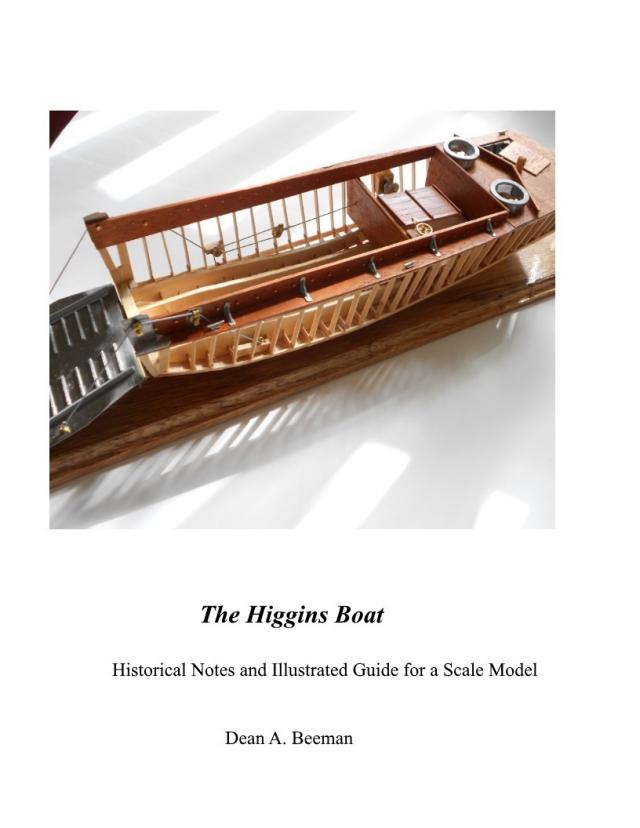
The Higgins Boat
Historical Notes and Illustrated Guide for a Scale Model
Dean A. Beeman
Copyright 2015-2017 Dean A. Beeman
All Rights Reserved
No part of this publication may be reproduced, stored in a retrieval system or transmitted in any form or by any means, electronic, mechanical, photocopying, recording, scanning or otherwise without the signed permission from the author. Excerpts made be used for review and promotional purposes.
Limit of Liability/ Disclaimer of Warranty. As the author points out in the text, the instructions in this book involve the use of sharp and otherwise dangerous tools and other items. The author makes no representation that injury will not occur. The author does not guarantee that the results obtained will be acceptable to any person undertaking this or any related project. The instructions and images may not be suitable for any given situation. The author shall not be liable for any errors or omissions, loss of any amount of money including lost profit or any other personal or commercial damages, including but not limited to special, incidental, consequential, personal injury or any other damages.
Table of Contents
Preface
The Higgins Boat
Construction Overview
Tools and Materials
Keel and Frames (Ribs)
Bow Structure
Transom
Bow Ramp
Drive and Control
Preface
Working on other boats in this series I ran into a couple of interesting wooden boats. These were both built by the same man- Andrew Jackson Higgins.
Obviously, a patrol torpedo boat would be an interesting project. Most were built by the Electric Launch Company (Elco), some early designs trace to Sparkman and Stevens, and Higgins Industries built about half (199) of them.)
I spent some time on this candidate, mainly because it’s a very popular concept and there are many online images available. Museums seem to prefer this boat, probably because it’s exciting. Let’s face it- the PT boat deserves all of the attention that the literature has given it.
But in terms of significance, history, and hands-on (or, more accurately, boots-on) experience, the LCVP (Landing Craft Vehicle and Personnel) and its variants saved a lot of American lives and played a far more important role in defining amphibious warfare.
In the Pacific, if there ever were such things as wedding rings between the Marine Corps and the Navy, this boat is one of them. The Hospital Corps is the other.
Much like the other models, this is not really a model at all. It is more a statement of beliefs that now include those of the sailors, soldiers and other everyday citizens who saw this country through a number of wars beginning with World War II.
Unlike the other books, this one won’t contain a lot of that history. Simply because this boat has been named many thousands of times by authors, including me, who mention a “landing craft” as if it were a sidewalk that somebody built for people to walk on.
And like the whaleboat, and for the same reasons, these boats have disappeared. Vanished.
But for this boat I can rely on documentation instead of speculation. That’s good. What’s not so good is that once you depart from US Navy blueprints you’ll find yourself adrift in a sea of misinformation.
In ancient Rome, the most popular spectator activity was watching humans being slaughtered by other humans, lions and dogs. Apparently, there is still money to be made on cable TV and elsewhere by appealing to that sensibility.
My opinion is that people who relish war at any level have never been in a real fight.
Watching fat old white men firing blanks at each other in a cornfield is, I suppose, the congressional version of war. Now if the re-enactors would pack all their fake uniforms, phony battle ribbons, blanks and weapons and schedule their next party at a resort in, say, Iraq or Afghanistan, I’d be more than pleased.
In the meantime, I’m building a model of and for what it was- a very important part of an important lesson. That lesson included killing hundreds of thousands of men, women and children who should not have died. Paying attention to today’s news will bring you up to speed on how much we’ve learned.
Unless noted otherwise, my reference text for Higgins Industries and Mr. Higgins are drawn from “Andrew Jackson Higgins and the Boats That Won World War II”, Jerry E. Strahan, Louisiana State University Press, Baton Rouge, C.1994.
Most of the narrative and unit volume devoted to Higgins Industries in the text revolves around wooden boats- PT boats (199 boats, displacing 50 tons apiece) and LCVP’s (9,000 boats, 9 tons apiece)-all delivered to the Navy, over a 5-year period during World War II. Most of the raw material tonnage can be accounted for by studying production volumes for steel boats and ships (LCM (3)’s Navy), and coastal freighters and barges (Army). Details are available from other sources.
Along the way I also looked at a Linberg model (in production since the 1970’s) that (at least on the outside of the box) to be an exciting model of LCVP KA-16-17, making it boat 17 on the USS Aquarius (AKA-16). So far so good.
Unfortunately, the model tries to combine battle scenes that couldn’t happen with details that didn’t happen. I own one of those kits, but I decided that the plastic model, like a number of photo captions and historical texts, is not quite right.
The references for my schematics and all aspects of this build are from various blueprint rolls preserved in the Higgins Industries Collection, Louisiana and Special Collections Department, Earl K. Long Library, University of New Orleans (UNO). Many thanks to James Lien, Library Associate, for helping me track down the original drawings and fabrication notes. It might take a while online, but once you’ve located Series VII you’re into the chronology and actuality of the Higgins Boat. And many of the drawings contain mini-histories of their own.
The Higgins Boat
The Higgins Boat does not need apostrophes. It was and still is that well known.
Dwight Eisenhower once said this:
“Andrew Higgins ... is the man who won the war for us. ... If Higgins had not designed and built those LCVP's, we never could have landed over an open beach. The whole strategy of the war would have been different.”
-Wikipedia
Let me add that he was referring to beaches on just about every continent. (And I believe that Ike was the perfect man for his roles in American history.)
There were many design iterations of this boat.
The first was really a series of prototypes that started with a work boat (the Eureka type) that combined a planing forward hull with a flat center hull and a prop tunnel. Combine those design elements with light, indestructible wood (mahogany) and oversized fasteners, and you’ll have a very fast boat that is perfect for navigating shallow, treacherous bayous. Or, in the 21st century, a boat that can exploit the benefits of a jet drive.
The raw material for all of Higgins’ wooden designs was a Philippine mahogany laminate that is referred to as “Eurekawood”, (a 3-7 ply marine plywood). Other important woods were oak, spruce, loblolly yellow (or Southern) pine and dimension mahogany. Most of the structural supports and fasteners were galvanized iron or bronze, and most mating wooden surfaces were sealed with bedding compound (dolphinite). The best characteristics of these materials were combined in the LCVP, as we shall see.
A series of designs evolved over time from the original Eureka series. Some writers reference the 1942, 1943 and 1952 designs, but that is not totally correct. In addition to the US Navy, there were British, US Army (J-boats) and even a Department of the Interior design. These are all obvious in the differences between the various rolls (complete sets of a single design), resident in the UNO library.
The rolls contained in “Series VII: Plans and Drawings: Landing Craft Plans”, (the library’s title heading), trace the evolution of the boat back to 1936 (the “Wonderboat”). The first reference to a “36-foot Landing Boat” is dated 11/15/1940. This was presumably the boat that the Marine Corps wanted, but the Navy’s Bureau of Construction and Repair (BCR) didn’t. It was part of a prototype competition that Higgins won, according to the Chief of Naval Operations, but lost according to the BCR. (It took a while, but the Navy eventually cleaned house at the BCR, only to discover during the Korean War that arm-chair captains always survive.)
Within that single reference heading there are over 1,500 individual drawings, most devoted to the LCVP and variants of the boat we’re going to build.
And from that reference heading, here are the design iterations of the LCVP as designed and built by Higgins Industries:
I have chosen the Tables of Offsets as the most definitive description of a design. There are many other drawing titles that do not map to that heading, including a 1952 drawing that is dated after Higgins’ death (8/15/1952), and was not built.
According to the drawing notes, the first 20 boats and the next 580 (with modifications), were designed to the blueprints contained in Roll #69. The drawings that made up most of the wartime production are probably contained in Roll #’s 69, 54, 22 and 9. (The drawing dates have little or nothing to do with the design or production dates- they’re a handy reference, but they’re the dates of the last revision, not the first.)
So, the LCVP, like the PT boat, evolved to match battle realities. The hull sides became flatter (thus easier to build and plate with armor), the coxswain position (helm) moved from the center of the rear deck forward to a lower position next to the engine compartment, and light machine gun turrets were ad ded to the rear (aft) deck. (I have some thoughts on the model and caliber of those machine guns that we’ll eventually deal with.) Since the Pacific theater involved many landings (and evacuations of wounded men) on shallow beaches, the skeg (rubbing, or false part of the keel that protected the prop and rudder) was made longer and more substantial, and the entire lifting design was simplified.
There are a number of diagrams for these boats available online, but very few of them carry a design date or footnote and some of them mix and match various design iterations on the same page. The last LCVP manufactured by Higgins was boat #20,094 that came off the assembly line in 1945, right after V-J Day. Strictly speaking, any boat built or modified after the final blueprint date is an LCVP but is not a Higgins Boat.
On another reference note, you can look up the real Aquarius on the Navy’s DANFS (Dictionary of American Naval Fighting Ships). The Aquarius and the other attack cargo ships (troop carriers) are interesting all by themselves since they were forward combat ships and all won battle stars. You should look her up, along with her sisters. She is also unique in that she was manned by the US Coast Guard.
As a matter of fact, stop where you are. Go to Wikipedia and look up the biography of Douglas Albert Munro, Signalman First Class, USCG. Battle stars are just one part of the story in the Pacific.
This may be the place to point out that the crewmembers on these boats all volunteered for duty and had to undergo extensive classroom and hands-on training on every aspect of the boat. This is not a minor point- before one of these boats was launched the crew knew the best ways to accept soldiers, jeeps and the wounded, how to land the boat on a hostile beach, and how to repair their boat under combat conditions.
After the Japanese Navy was defeated at sea, the Japanese Army knew that one clear way to avoid defeat on their occupied islands was to destroy these plywood boats. And most of these boats were not armed or armored, placing the coxswain and crew in harm’s way on each of many runs to the beach.
Finally, this was an enlisted man’s boat. By that I mean that it was not under the command of a commissioned officer. This may explain why President Eisenhower and Admiral Morison are at such odds when it comes to the boat’s strategic importance.
A kinder explanation may be that the Navy’s Bureau of Ships had developed a number of landing craft that were consistently in opposition to the Marine Corps, the Army and the concepts of logic and seaworthiness.
Mr. Strahan devotes many words to this last conundrum.
With all of that out of the way I’m going to start this build where each boat started- the factory floor in New Orleans.
Construction Overview
The next photograph is very important to this build because it shows (in a slight blur) Higgins boats in the early stages of hull construction.
This photo was taken inside the second floor of the City Park Avenue plant, at 5 million square feet the largest boat-building facility in the world. It isn’t obvious, but these boats are being built on what has been described as a movable assembly line. (Based on this photo I believe “movable” to be a careful choice of words) At the end of the process a completed boat was lowered by elevator onto a flatbed railroad car and sent to Bayou St. John for testing and acceptance. (Dry production is common today, but at the time most boat builders conducted product testing in whatever body of water was outside the back door.)
As a final note on this factory, most of the narrative and unit volume devoted to Higgins Industries revolves around wooden boats- PT boats (199 boats, displacing 50 tons apiece) and LCVP’s (9,000 boats, 9 tons (17,500 pounds light, 26,300 pounds loaded)-all Navy, over a 5-year period, most built here. Most of the raw material tonnage (including 100 FS/FP coastal freighters (Army, 575 tons), another 300 barges(Army) and all 50- foot LCM (3)’s) would have been steel, and built in other plants.
The story of how and why the Army Corps of Engineers assembled operational LCM (3)’s 10,000 miles away from where these boats were fabricated is a pretty amazing diversion that you should take while your glue dries.
In the meantime, let’s get on with the LCVP.
(If this version is too small, do a search and pick the largest version of this photo you can find. There are dozens available at various pixel counts.)
A partially-built hull is at lower left- dead center. That boat shows the holding frames, a transom assembly ready to be fitted, and the notches that will accept the keel and apron (keelson). To the left of that boat is a boat with the transom frame and keel assembly fitted.
We’re going to spend a lot of time to get the model to the same stage of production, or what amounts to intermediate assembly.
I’ve had to remind myself that Higgins had over 12 years of experience with marine-grade lumber and boat construction to get to this point. And behind this scene are other complete manufacturing facilities that produced marine plywood and finished dimension lumber from raw logs. These finished materials were then cut, drilled, and formed into parts. So, the photo captures what I believe is a minor part of Higgins’ intellectual and practical investment. And hides a lot of hard work.
Tools and Materials
Every model-building text starts with a tool description. I built my first scratch model using a machinist’s rule, a razor blade and scraps of sandpaper. That model took a while, and I’ve only added tools that fit what I needed. My advice is to read the text, figure out what tools might be handy, and buy them only if you feel you need them. What comes next is the result of many, many models, including the ones in this series.
And while I started this series of books with a description of a set of tools for each model, the sets began to look very similar, so here are most of the things I use every day. (In order left to right, top to bottom.)
Scrap Bins- one for short and one for long scraps. Indispensable.
Cord Box. In this assortment, I have rigging cords that start at .008 all the way up through sewing thread, button thread and 48-pound hemp.
Clamp Box. In here you’ll find wooden clothespins, adjustable bar clamps, bulldog clamps and paper clamps. Almost hidden in front of that are a couple of ship model planking clamps- I have many more, and they are very handy.
Sanding Wands. I’ll describe these later. There are also some emery boards, a round, small wand and one scrap of many scraps of sandpaper.
Micro files. Sharp and broken-off round, plus the normal assortment. Very handy.
Fences. These are metal rulers, a machinist’s rule and a machinist’s square. All stainless steel, to stand up to the knife blades.
Loupe. Only handy if your eyesight is as bad as mine and the work is really tiny. (It will be tiny as we go along.)
Glues. CA gel, craft and wood glue. Mandatory.
Template Bin and wire. All small templates, subassemblies and small parts I’m working with on a given model go in here or they’ll get lost. We won’t be using that much wire or brass rod.
Pin Board. This once was a piece of foam craft board that now has hat pins and various other pins that I use for marking, gluing, clamping and other things that I forget until I need a specific pin. Stuck into the side are sewing needles of various sizes- there is no logic to explain how they got there.