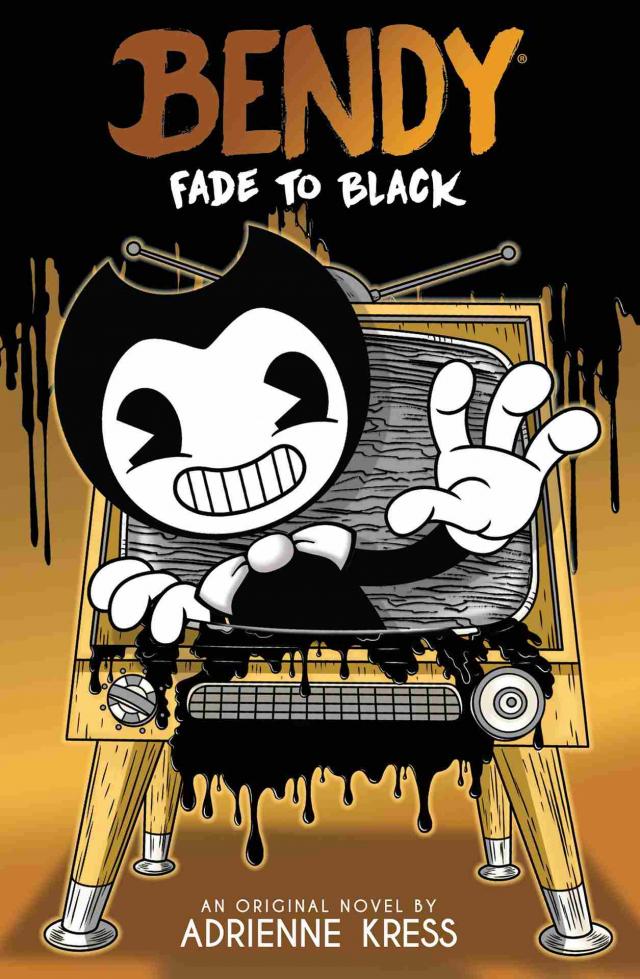
Fade to black, p.1
Fade to Black, page 1


To all the Bendy fans, old and new.
To people who like to tell scary stories in the dark.
And to the incurable optimists.
—A. K.
Contents
Title Page
Dedication
Fade to Black
Prologue
1
2
3
4
5
6
7
8
9
10
11
12
13
14
15
16
17
18
19
20
21
22
23
24
25
26
27
28
29
30
31
32
33
Acknowledgments
About the Author
Copyright
Every ending is a beginning. And every beginning finds its end. And so the cycle continues. On and on. A loop on repeat. Drawing itself into itself. Further and further into the shadows. Until you are completely consumed.
It’s best not to fight it.
Or maybe that’s a lie.
Maybe that’s what they want you to think.
The darkness.
And the ink.
If you were to walk down Broadway in January 1953, on a day when the snow is falling but the wind blows so fiercely that everything flies at you sideways, where snowdrifts are flattened and cars emerge from the white, like monsters in the dark—if you were to walk down Broadway on a day like that, you would have entirely walked into the chaos without realizing it until it was too late. You might have walked into one of the large hulking men in heavy overcoats and muffs on their ears, or flat caps on their heads because they’d lived in the city long enough and “didn’t need no protection.” Scarves around their throats, up to their mouths, damp on the inside from breathing heavily.
“Of course it had to storm today,” one would say and another would grunt and agree. Then a large steel door would burst open. One of those doors you don’t even notice are there until you do. Then you might actually look around you. Look up at the building in front of you. You’d see boarded-up windows. An abandoned warehouse, you might think, right here in the middle of Broadway? Right under your nose?
You might think: What else goes on in this city that I don’t know about, right under my nose?
“Can I help you?” you might offer as two more large men emerge from the dark inside, carrying large boxes and wheeling heavy crates. You’d notice then that the boxes are stamped with the word “Gent.” You might wonder if that was short for “Gentleman,” maybe they belonged to an old suit factory. The men would ignore you of course, because they have everything under control. Even as they huff and puff and complain, they know what they’re doing.
One of them steps to the side after heaving his end of a crate into a large moving van. He places his hands on his lower back and stretches, the scarf slips around his mouth, the snow finds his mustache quickly.
You don’t know why you’re so curious. You don’t know why it matters. But you might try to make small talk. Even though you have places to go to, and things to do.
“What’s all this? Why in a snowstorm?” you’ll call out over the wind.
“Has to be done fast. Has to be done now,” says the man with the mustache.
“What is all this?” Because the boxes are all such different sizes and shapes and make no sense to you, and again, because something compels you to ask. You might rub your hands together a bit, trying to warm them up.
“Your guess is as good as mine, kid.” But then he’ll decide he doesn’t want to go back to work right away so he’ll say, “Some strange things in there, experiments looks like. You probably don’t want to know.”
What a surprising answer, something you had not anticipated. The building looks so dreary, no hint of life or strange goings-on. “Where are you taking it all?”
“To the Kismet Production Studios, other side of the city. For TV, you know. TV is going to be the next big thing, mark my words,” he replies, brushing the snow that has accumulated on his mustache.
You’ll nod because you already think it is the big thing, nothing next about it. He won’t see it though. Through the snow, the wind, even just turning to look at someone is a struggle.
“Harvey, what do you think ‘under the radar’ means!”
“Oh yeah, sorry.” He might look at you now and mime locking his lips, then say, “Forget I said anything.”
“Harvey, get over here.” And then some choice profane words in the style of all New Yorkers. It doesn’t bother you because you are also a New Yorker.
If on this day you were to do all this, you may have been part of a very small slice of history. Something that only a choice few ever really knew anything about, and those who did have long forgotten. You would have seen a massive crate, large enough to hold a car, which is the only thing you could think to compare it to, be craned over, held by large heavy chains, watch it creak in the wind as Harvey trudges his way over to help steady its descent from a window up high.
You’d have seen the word “fragile” in large, black, inky letters along each side beneath the word “Gent” again.
You’d have felt the wind pick up speed.
If on this day you had been there. To witness both the beginning of a thing and the end.
But of course you weren’t.
And you never saw it.
And the truck, once loaded, drives off into the snow, disappearing into the flurries. And there is a stillness next to the building.
And then from deep within the walls a sound like an echo of something. Like a roar or a scream.
Or maybe it’s just the wind.
From an old journal found in Joey Drew’s Greenwich Village apartment in 1972, dated New Year’s Day 1953.
The Illusion of Living Second Edition
PART VII
The End Is The Beginning
The end of Joey Drew Studios was part of a well-laid plan. The studio closed in 1948. Now you may feel some level of sorrow for me, old Joey. You might concern yourself that I was heartbroken. But
Sometimes when I’m asleep I dream I’m in Bendy’s world. The walls around me cartoonishly pulled high into the sky, warped and mangled, drawn by hand. And the ink seeps between the cracks in the planks of wood. I dream I’m walking down a hallway, the floor covered in ink, like the shallows of an infinite bay. He calls out to me. They all call out to me. And I wonder if I am truly dreaming or if I’ve slipped into another world. A world more real than what we call real.
I wake up. I am in my bed.
My studio is gone.
But I am not.
I am here.
And dreams never die. They just shift and squeeze themselves through different cracks. Until they find you again. Consume you again. I will wait until they do. I can be patient.
I’m not frightened.
I’ve never been scared of the ink.
No one will read this no one will read this no one will read this no one will read this
I have always been an incurable optimist. That’s what my parents called me at least. It made it sound like I had a disease. In fact, the first time Mother ever told me this, I genuinely panicked. I was very little, and I didn’t know what “optimist” meant. I just knew it was a big word, and big words frightened me. I figured that big words were invented to hide the truth, because if you wanted to just say something, there were a lot of little words that worked. Of course now that I’m almost officially an adult I feel differently. Big words are marvelous and exist to be even more precise in our communicating.
But when I was little, well, I thought my mother was telling me that I was going to die.
I cried so hard I could barely breathe as she held me close, desperately trying to explain that being an optimist was a positive thing.
“An optimist sees the good in the world. They are happy and positive.”
Still more sobbing.
“Don’t you see, Rosebud, you bring us such joy!”
“I. Don’t. Understand,” I said between heaving sobs. Snot flowed out of my tiny nose. I remember that very well. The grotesque has always fascinated me, even as I evidently went through life as if skipping through a meadow. At least according to my mother’s perception of it all.
Mother’s hand released her tight grip on my heaving back. Even so young, I understood she was trying a different tactic with me. “Not everyone sees the world like you.” Her warm hand slowly started stroking my hair. I almost instantly felt calmer, even as I clung to her knee with my sharp little nails digging into her leg.
“I don’t see the world as anything!” I insisted, feeling desperate, but my breathing became more regular.
“Rose, we all have our own little ways of looking at the world. Some people see only bad things. They see dangers and grumpy people.”
“I see dangerous things! I always look both ways before crossing the street.”
“Of course you do because you’re a good girl.” A heavy sigh as my poor mother tried to explain the concept of internal bias to a six-year-old. “It’s like this: You know how yesterday it rained?”
“Yes, I know that.”
“But we still dressed you up in your raincoat and boots and went to the park a
“Of course I remember. It was only yesterday.”
“Well, was it a good day?”
Five-year-old me rolled her eyes very hard at that, which was tough because my face was smushed into her leg. “Of course. We jumped in puddles.” Puddle jumping was amazing; Mother understood I felt that way. What she didn’t understand was why it was amazing. Sure, the splashing was the best part. But I liked how the world was all upside down in puddles, how it wasn’t quite like a reflection in a mirror so it looked kind of like another world was inside there. I always thought that if you jumped hard enough you could jump right into a whole other world, the same as ours but a little different. Mother didn’t know that part. She wouldn’t have understood anyway. It was my own private little secret make-believe.
“Well, you see some people might have thought yesterday was a bad day because it rained. Because it was gloomy and not sunny outside.”
“They would have?”
I pulled my face away and looked up at Mother. She was very pretty, and her halo of curls always made me feel warm inside. “Yes,” replied Mother. She smiled that soft smile back. It was a special kind of smile, only for me. And for Ollie. Though Ollie wasn’t around yet. So I thought at the time it was a secret thing between mother and daughter. But it turned into a secret thing between mother and daughter and son. Which, of course, I was perfectly happy with. Especially since Ollie and I had our own secret looks between us.
“They don’t like puddles?” This was a hard concept for me to grasp.
Mother let loose a small laugh and sat us both down on the settee. She held me in her lap, her arms wrapped around my waist, mine around her neck as I stared at her intently.
“Some people can only see the disappointments, the bad things in the world. But you see the good.”
“Because the good is there,” I explained.
“Exactly,” she replied. She pulled me in close so I could feel her warmth and smell her perfume.
I thought about it all, about seeing the good in things and being an optimist. I thought it was funny: If I saw good in everything, then why had being called a word I didn’t understand fill me with fear? Shouldn’t I have thought it was exciting? Me, the incurable optimist? Maybe I was more complicated than Mother understood. I decided it had to be that. I also really liked the word “complicated.” It sounded complicated in and of itself.
“I still don’t understand,” I explained, though not able to articulate my doubts. “All I said was that Father would be home safe and sound soon.”
“I know.” She squeezed me tighter.
“That isn’t being an optimist. That is just the truth.” Now she squeezed me so tight it kind of hurt a little.
“I know, Rosebud, I know.”
And then it was Mother’s turn to cry.
“I got the job!” I burst into the foyer and I think I did expect that all three of them would be standing, waiting with bated breath for me to return from the city, but it was empty. As it always was. It made sense—who spends their free time in hallways after all? But I heard my mother’s “Yay!” from the kitchen and I followed the sound to find her and Ollie together making banana bread. Or at least she was. Ollie was just covered in a mess of ingredients. If there was one thing I knew about the kid, he liked to sneak a taste.
“The TV job?” asked Ollie. He was a boy obsessed. Even though we couldn’t afford our own television, Ollie just thought it was the keenest thing. Your own little movie theater right in your front room. And his friend Pete had one. We all knew that. We all went to the big party to unveil it and watched The Jack Benny Program together, piled into their tiny sitting room. Kids on the ground in a heap, parents on the sofa, a few kitchen chairs, or leaning against the archway into the room.
I ran over to give his hair a tussle and a safe, ingredient-free hug. Not easy—he was really covered head to toe. How on earth did he do that? “You proud of me, little guy?” I asked.
“I’m always proud of you, but yes, this makes me extra proud. I’m going to go tell Pete.” Ollie was up on his feet but Mother had him by the shoulders almost instantly.
“Not until after we finish. We don’t leave a task halfway through.”
Ollie nodded and sat back down. He was such an amenable kid. He wasn’t like the other seven-year-olds on the street, boisterous and trying to jump on the back of the milk truck. He played outside, he had his friends, but his energy was very contained. A small orbit around just him. Though he did get very competitive when we played marbles; with that it was every boy or girl for themselves.
“Why don’t you go tell your father. He’s in the living room.”
I nodded and smiled; I was already planning to. But her tone of voice said more than her words. I knew it well. Father was having a bad day. A puddle day, child me might have called it. Even now, nearly eight years after his return, he had these days. They were fewer, and he was able to work now and spend whole weeks in our world with us. But he still had these kinds of days. Telling him my good news would hopefully break him out of it.
You see, Father had thankfully not died in the war. That was the good news. That was all that had mattered to me when he came home. It hadn’t bothered me that he looked skinnier than when he’d left because, at ten years old, I had lived almost double my life by the time he returned, and who he had been before was a faint memory to me. Almost like a dream.
A dream.
While my father lived in a waking nightmare.
That was the bad news.
The older men in the neighborhood called it “shell shock” and Mother said it was “combat fatigue.” Neither was a term I had heard before, but I knew a lot more words now, at nine, and I was excited to learn some more. But these words did not make me feel good even with my optimistic outlook. I tried, I really did. I told Mother that the important thing was that he was home, and that he was still good at hugs. That we were a whole family again.
But as the months went by, Father retreated further and further into himself. He was becoming a shadow even as Mother grew bigger and bigger because of Ollie. Mother was round and rosy, but her hair was thinner. And while she smiled and played with me still, I saw her expression darken every time I caught her in a quiet alone moment. When she thought no one was looking. Sitting in the shadows, like a darkness had passed over her.
Darkness played with our family a lot in those first few years after Father returned. There was love and kindness there, but my parents would dip into those shadows. Mother and Father could be taking Ollie for a walk in the pram, and I could be running beside them with my jump rope, the sun could be out, not a cloud in the sky, but still the darkness would find them. I saw it fill them up, like pouring water into a glass, higher and higher, to the very top, spilling over. I desperately wanted to brighten them up, but how could you shine a light inside a person?
As a child I had called them puddles. I always liked playing in puddles when I was very young. Splashing around. The idea of them being portals to other fantastical worlds. But, the older I got, the more I came to realize what puddles actually were: dark and murky water, where your reflection looked back up at you from below, grotesque and brown, and if you jumped too hard it got water in your boots. Made your feet squishy. And so, at eleven years old, I said it one afternoon. When Mother disappeared inside herself again, it was like she’d fallen into darkness, into a puddle. It felt right, it felt accurate. “Are you in your puddle again?” I’d asked as I saw my mother seep into her faraway thoughts.
And Mother, who had always appreciated my cleverness with words, gave me her soft smile. The smile just for me and Ollie. So I said it again the next time, and the next. And each time for a moment she’d step out of the puddle, dry, crisp, clean and reach out for me. And sometimes she’d stay a while. But other times she’d slip back quickly, and I’d have to take baby Ollie onto the stoop and we’d play in the sunshine. Where it was safe.
The problem was that on the outside Father looked healthy. Father looked well. He came back entirely intact on the outside. He could do chores, he could fix a leak or shingle, he could pick up Ollie. I know that some of my friends were mad at me because of that. Because their fathers had not come back with all their limbs. And when Father came back, he came back entirely. But he hadn’t really and you couldn’t explain. You could try, and try I did. But how do you explain puddles to someone? How do you explain his screams in the night to your friend whose father woke up because of real pain?