

Advent, p.1
Advent, page 1


About the Author
Gunnar Gunnarsson (1889–1975) grew up on a farm in the Fljotsdalur district of East Iceland and went on to become one of the most popular novelists in Denmark and Germany. His career began with his first novel, Af Borgslægtens Historie (translated into English as Guest the One-Eyed), which was published by Gyldendal in 1912–1914 and was adapted for cinema in 1919, the first Icelandic writing ever to be made into a film. During the next two and a half decades, Gunnarsson wrote numerous novels, short stories, poems and plays. His books were printed in many countries though his popularity was concentrated in Denmark and Germany. Ships in the Sky made it to sixth place on the New York Times bestseller list in 1938. Advent, also titled The Good Shepherd, is perhaps his most enduring book and is still widely read today.
Philip Roughton was born in the US and now lives in Iceland. He is an award-winning translator of modern Icelandic literature, having translated works by numerous Icelandic writers, including the Nobel prize-winning author Halldór Laxness.
Gunnar Gunnarsson
* * *
ADVENT
TRANSLATED FROM THE DANISH BY
Philip Roughton
WITH AN AFTERWORD BY
Jón Kalman Stefánsson
As a feast day draws near, everyone prepares for it in their own way. Many different approaches are taken, and Benedikt had his own too. It consisted of his leaving home at the start of Yule, preferably on Advent Sunday itself, weather permitting, amply equipped with provisions – a few changes of socks and several pairs of newly stitched leather shoes in his rucksack, along with a Primus stove, a can of paraffin and a small bottle of methylated spirits – and heading into the mountains, where at this time of the year only winter’s hardy raptors, foxes and a few stray sheep roamed. It was precisely those wandering sheep that he was after, sheep that had been overlooked during the three regular roundups of the autumn. They certainly couldn’t be allowed to freeze or starve to death in those high places simply because no one bothered or dared to seek them out and bring them home. They too were living creatures. And he bore a certain responsibility for them. His goal was quite simple: to find them and bring them home safe and sound before the great feast day sanctified the earth and brought peace and contentment to the hearts of those who have done all that they are able to do.
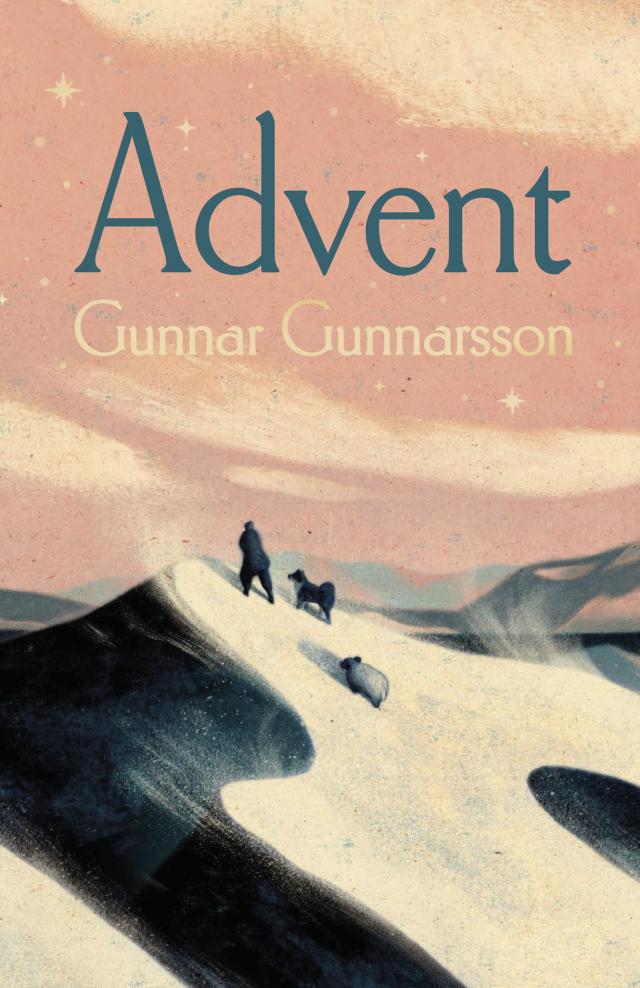
On this Advent expedition of his, Benedikt was always alone. Truly alone? He had no human companions, in any case. He was, however, accompanied by his dog, and most often, his leader sheep. His dog at the time of this story was named Leó – a veritable pope, Benedikt called him. Due to his toughness, the leader sheep, a wether, was called Eitill.fn1
For a number of years, these three had been inseparable when it came to such treks and had gradually got to know each other, inside and out, with the in-depth familiarity that is perhaps only obtainable between completely unrelated species of animals, such that no shadow of one’s own self, one’s own blood, own wishes or desires confuses or obscures things. There was, incidentally, usually a fourth member of the group, the good horse Faxi, who unfortunately was too slender-legged and heavy-bodied to trudge through early winter’s deep drifts of soft snow, and what’s more, was hardly fit to withstand so many strenuous days on the meagre rations with which the others made do. It was with sadness and regret that Benedikt and Leó parted from him, even if it was only for a week. Eitill took this twist like everything else: more stoically.
There that threesome went now, this winter day: in front was Leó, with the tip of his tongue sticking contentedly out of the right corner of his mouth despite the cold. Behind him was Eitill, even-tempered as always, and finally Benedikt, lugging his skis. Down here in the farmland, the snow was still too light and loose to carry a skier; he had no choice but to trudge through it, and of course ended up stubbing his toes on tussocks and rocks – oof. It was a fairly heavy slog, but it could have been worse. Leó had lots to look into, as dogs usually do, and was in high spirits. At times he couldn’t contain himself and simply had to let it out, bounding away and kicking up a cloud of snow behind him towards Benedikt, barking at him, jumping up at him and clamouring for praise and petting.
Yes, you’re a veritable pope, Benedikt would remark. That was his term of endearment for his comrade; higher praise couldn’t come from his mouth.
For the moment, they were making their way through the settlement towards Botn, the farm lying nearest the mountains. They had the whole day ahead of them and took it easy, following the path from farm to farm, stopping and greeting people and dogs, but a cup of coffee, no thank you, not today – we’d like to get there in good time. Instead, they had some milk – all three. Time and again, Benedikt was questioned about his outlook on the weather. People didn’t mean to be nosy or come across as doomsayers, they simply asked – as was their right, of course. And someone might add afterwards: Yes, what I wanted to say was, Leó must be the kind of dog who’s good at finding the way, even in darkness and snow? It was said almost jokingly, eyes fixed on the ground to avoid alluding to the sky’s somewhat-threatening clouds, even if only with a glance. And someone else might interject spiritedly: Find the way? That he can certainly do, the mongrel.
All three of us can, Benedikt replied unconcernedly, before finishing his bowl of milk. Thanks for the drink.
Nothing against you and Eitill, but I would rely mainly on Leó, said the farmer, before popping out of the door and fetching a treat for Leó to munch on.
Benedikt made no comment about Leó being a veritable pope, but let the dog know with a nod that he was free to take his time eating the food offered; he could wait that long. Meanwhile, Eitill got a capful of fragrant hay from the farmer’s homefield. Then the three of them set off again.
Benedikt hadn’t gone to church that day. No, that he hadn’t done; there wasn’t time for it. In order to reach Botn at a decent hour and get some rest before the following day’s early departure and long march, he’d had to make the best use of the day, starting early that morning. It was mainly out of consideration for Eitill that he set a gentle pace this first day. Not that Eitill couldn’t cope with going faster or didn’t live up to his name. But Benedikt had to be careful not to overexert the wether from the start. That’s why he couldn’t very well make a detour to the church. Every Advent Sunday, it was this amble of his through the settlement towards the mountains that was his churchgoing. What’s more, before he left home, he’d sat on his bed in the family room and read the day’s scripture passage, Matthew 21, concerning Jesus’s entry into Jerusalem. But the ringing of the bells, the singing of hymns in the small turf-covered church and the old priest’s wise and sedate exposition of the Gospel, he’d had to imagine. And he had no trouble doing so.
Here he was now, walking in snow, white on all sides as far as the eye could see, a greyish-white winter sky, even the ice on the lake was frosted or lightly covered with snow, only the rims of the low craters sticking up here and there drew larger and smaller black rings like a portentous pattern in that snowy waste. But a portent of what? Could it be discovered? Perhaps these crater mouths said: Let everything freeze, stone and water solidify, let the air freeze and sprinkle down as white flakes and lie like a bridal veil, like a shroud over the ground, let the breath freeze in your mouth and the hope in your heart and the blood to death in your veins – deep down, the fire still lives. Perhaps that is what they said. And what, then, did that mean? Perhaps they said something else, too. In any case, apart from those black rings, everything was white, particularly the lake – a glistening white surface, smooth as a dance floor. Who laid it there and invited us to dance?
And as if born of all this whiteness, with the craters’ black rings and solitary troll-like lava pillars rising here and there, an air of solemnity marked this Sunday in this settlement near the mountains, something that tugged at the heart. An immeasurable, pure holiness surrounded the placid Sabbath smoke that rose undisturbed from the scattered, low farmhouses that nearly disappeared beneath the snow, an incomprehensible and unimaginably promising stillness. Advent. Advent! Yes … Benedikt mouthed the word gingerly, that big, quiet, wonderfully alien yet at the same time homely word, perhaps for Benedikt the most deeply homely of all. Admittedly, he didn’t know exactly what it meant, yet there was expectation in it, anticipation, preparation – that much he understood. As the years went by, that one word had come to encompass practically his entire life. For what was his life, what was man’s life on earth, if not an imperfect service, sustained by expectation, anticipation, preparation?
They arrived at another farm and the workday met them with its rural friendliness, but coffee, no thank you, not today, they were in a bit of a hurry, the days were getting shorter, thanks all the same. The farmer considered the sky long and carefully, and frankly didn’t think much of the weather prospects. Well, we simply have to take the weather as God gives it, thought Benedikt. The farmer, for his part, could only hope that the storm broke loose before nightfall! Such talk was certainly not to Benedikt’s liking, and, well, they had to be going.
Are they of any use, those companions of yours? asked the farmer, reluctant to watch the man go, perhaps seeing him now for the last time, who knows? He’d had such troublesome dreams recently, and these three had a quite-obvious aura of impending ordeals – if not something worse. Isn’t Eitill just a millstone round your neck? Can you rely on them, him and the dog?
Can I rely on them? replied Benedikt. All three of us have been through a bit of everything.
A person shouldn’t say such things at a perilous hour; mustn’t provoke the powers so presumptuously. Making no reply, the farmer let him go, and off they went, the three of them, leaving an uncertain man standing there, chewing tobacco as he watched them walk away, dissatisfied with himself and them and the whole world. Who could understand such people, risking everything – even life itself – for some sheep belonging to someone else? Of the few sheep that Benedikt himself owned, none were missing.
For his part, Benedikt probably had just as little understanding of the prudent farmer. Whatever the case, the three went on. Today was a good day, a good and solemn day, and no one was going to ruin it for him. It was many years ago today that Jesus made his entry into Jerusalem. Knowing this, he could feel, too, how the day had retained a touch of that event over the centuries. Benedikt envisioned Him so clearly as He rode into the glorious, sun-drenched city, whose walls and buildings, along with Jesus riding the ass, he had seen illustrated in a Bible history. The branches that people cut from the trees and threw before the ass’s hooves were shaped like frost roses on a windowpane, but they weren’t white, that he knew well. They were green, lushly green, and with something of the sun stored in their smooth leaves. And suddenly the words of the old book carried almost audibly through the air, as if the waves of the ether had preserved them and all you had to do was lend them an ear: ‘Behold, thy King cometh unto thee, meek, and sitting upon an ass, and a colt the foal of an ass.’
Meek, yes. Benedikt understood that. How could the Son of God be otherwise? And riding on the foal of an ass, a beast of burden – for of all that is living or dead, there is nothing too humble for service, nothing that is not sanctified by service. And only by service. Even the Son of God. Only by service. And just then, it seemed to Benedikt as if he knew the little ass and realised fully how it and the Son of God felt at that holy hour. And in his mind, he vividly saw people spreading their best garments on the road, and he heard others asking: Who is this? Imagine that: who is this! For they did not know the Son of God. Yet they ought to have known Him. A smile shone on His deeply simple face, which was dimmed just a little by sadness at how they knew no better, that their eyes were so clouded, the mirror of their hearts so fogged. And at the sight of that sorrowful smile, Benedikt’s temper flared: how blind they must have been, to stand face to face with the Saviour and not recognise Him! He himself would have recognised Him immediately, at first glance – of that he was convinced. And he would have joined Him straightaway and helped Him to drive out those insolent villains from the temple and overturn the tables of the money changers and the seats of those who sold doves.
At these thoughts, Benedikt loosened his leather cap, wiped his forehead. Walking wasn’t particularly strenuous for him, but these pugnacious thoughts made him sweat. He was a peaceful man; it had never so much as crossed his mind, at least not since he became an adult, to use violence against others. But at the Saviour’s words – ‘My house shall be called the house of prayer, but ye have made it a den of thieves’ – at these words, a burning indignation kindled in him. Just imagine if the merchant decided to move his humbug store into their old turf church. There would be no peace. And with these words of the Saviour in his ear, he felt ready for whatever might come, under the Lord’s guidance. Money changers, certainly. Dove sellers, yes indeed. Hucksters in general! He knew who they were. Best to think as little as possible about them. Again he wiped his forehead. And as for the hucksters he knew, the merchant and a few hawkers, he actually – despite whatever criticism they had coming – didn’t relish the idea of having to give them a taste of his fists.
Thus did Benedikt walk and think and have his joys and his worries, while the grey day gradually darkened around him and the full moon lit up behind the clouds and sometimes gave a glimpse of itself against the dim evening sky. He didn’t give too much thought to himself, did Benedikt, as he marched on. How could he? To the eye, now that the day was dwindling, he was gradually becoming only an indistinct shadow in the landscape. And yet, you could ask whether his self-image wasn’t even more indistinct and blurred. After all, he was only a farmhand, a labourer, and had been all his life. Or perhaps more correctly: half-farmhand, half-smallholder. There was, in fact, something incomplete and insignificant about him. Half-good, half-bad, half-human, half-beast. Ah, yes – it was no different than that! In the summer, he worked as a day labourer on the farm where he lived year-round. In the winter, he looked after the sheep there in exchange for board and some clothing. Only for brief periods in spring and autumn, along with the time that he spent on his Yuletide mountain trek, was he his own master. In addition, he had an outbuilding that was his own, a stable and barn for his horse, his sheep and his hay, which he mowed on rented meadows on Sundays after church. So, he had it good, and was of course just a simple man and servant, not expecting or aspiring to be anything else, not even in the Kingdom of Heaven – not any more. Those times were past. The days and nights when he dreamed dreams and harboured longings for happiness and leisure in this life and the next. Past, yes, and it was a good thing, too! Only then had he felt unfree. Since then, he had become a little more human – since then, yes, he had become human. Unless that was also vanity and reprehensible arrogance?
But in any case, he was already an old man, fifty-three, meaning he probably wouldn’t be going astray on too many long, wild roads hereafter. Fifty-three years – and it’s the twenty-seventh time he’s made this trip. He knows this precisely, keeps track of the number from year to year. The twenty-seventh time. He was twenty-seven years old when he started making these expeditions. Twenty-seven times he has traversed the settlement, setting out most often on Advent Sunday itself – as today. Oh, how time flies. Twenty-seven years … So deep did the dreams lie hidden. Those dreams. Which only he and God Almighty knew. And the mountains, to which he had cried out his dreams in despair. On his very first trip, he had left them there, where they lay well kept. Or perhaps they weren’t so well kept after all? Did they haunt the solitude of the mountains, like exiled spirits living their fugitive, distorted lives in a desert of snow and weathered rock? Was it in fact them that he had to go check on every winter, to see if they hadn’t yet faded and sunk into the earth? But he shook these thoughts off. No, he wasn’t that pathetic.
But now they were approaching their stopping place for the night and were trudging up the slope that led to the farmyard, Benedikt, Eitill and Leó. The farm buildings stood on a small stretch of hills surrounded in a semicircle by the slopes of the heath behind it. This was especially beneficial in the spring, when the sun gained strength, yet at the same time the buildings were nicely sheltered. Benedikt drew a single deep breath now that he had reached the end of the road for today, then turned and looked back at the path he had travelled. He had taken hold of one of Eitill’s horns, which felt warm at the base, and on the other side of him was Leó, wagging his tail. There they stood. It was something of a solemn moment. It was not as if Benedikt felt the heavens open above him, yet there was something of a rift in them; he wasn’t alone on earth, didn’t feel completely abandoned. Not completely abandoned, no. They stood there, and Benedikt looked out over the land and took in what he saw. Cool twilight descended over the high countryside as the day waned and the moon began to shine dimly from a sky where icy peaks drifted, peaks that appeared quite as real as the horizon’s fading mountain ranges with their dull contours of snow. The farmland looked flatter on an evening like this, when the lake was frozen over and the ice was covered in snow. And in the midst of that freezing world, which now merged with the dissolution into darkness, and as a part of that dim evening, stood the man, half-farmhand, half-smallholder. He stood there with his closest friends, the wether Eitill and the dog Leó – and that world was his. Here, he lived, as a part of all that he could reach and grasp with his sight and hand and thought and insight. This world was his. Of this life, he was a part.
Not that he thought of it in that way, not consciously. He didn’t even think once about how he had stopped here and stood looking out, because he usually set off from Botn before it grew light in the morning and was already high up in the mountains when day broke. He just had a kind of emptiness in his chest, a feeling of something lacking that couldn’t be pinned down or clarified – a strange, draining homesickness, but whether it was because he had to leave the settlement for a few days or because, when parting from it, he was always assailed by a reminder that in a while he would have to leave it forever, he didn’t know. For a man clings to his things, clings to himself and his things beyond death, fearful of losing his life – this most real of all that is real, this most fragile of all that is fragile, this most infinite of all that is infinite – fearful that it will slip from his grasp. He fears the loneliness that determines his self and is his self, fears being without his fellow humans around him, perhaps forgotten by God. It’s a small comfort to think that he’ll be buried here, if all goes well, and will remain firmly anchored in the earth. And he hopes that from the beyond, he’ll have, when time allows, a view of his home district; anything else could hardly be conceivable.






